How Reliable Are Buses In Albania?
An honest look at how reliable buses and furgons are in Albania, with the verified Tirana to Berat route facts, what goes wrong, and when a tour beats a bus.
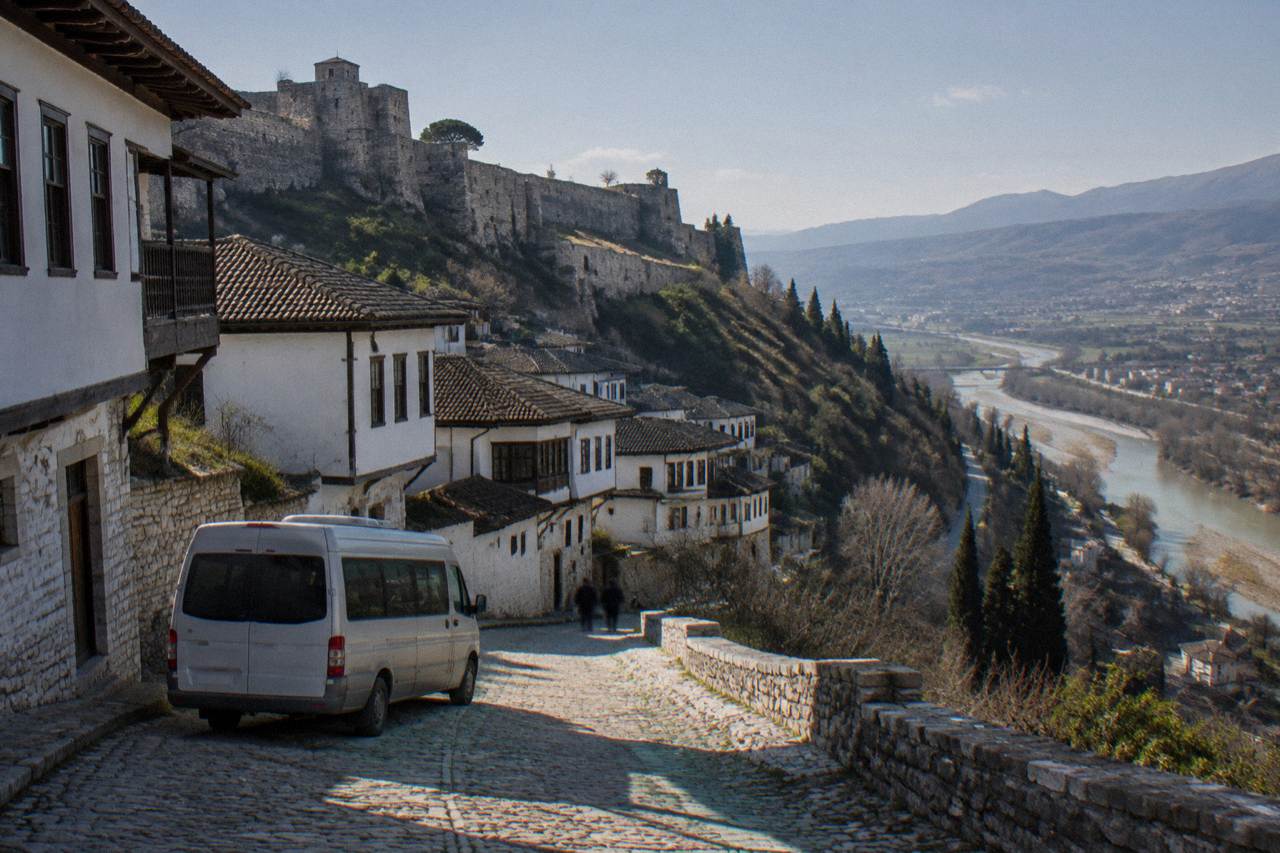
Albania moves on buses. The country has no passenger railway worth planning around, its towns are stitched together by long-distance coaches and smaller furgon minibuses, and Berat, the UNESCO World Heritage Ottoman hill town on the Osum River in central Albania, is reached almost entirely this way. Travellers arrive having read that Albanian buses are chaotic, unscheduled and not to be trusted. The reality is more boring and more useful: the system is informal but dependable, schedules exist even when they are not printed anywhere, and the routes to Berat run often enough that you rarely need a plan B. This page explains what reliable means here, what genuinely can go wrong, and when a guided tour is simply the better choice.
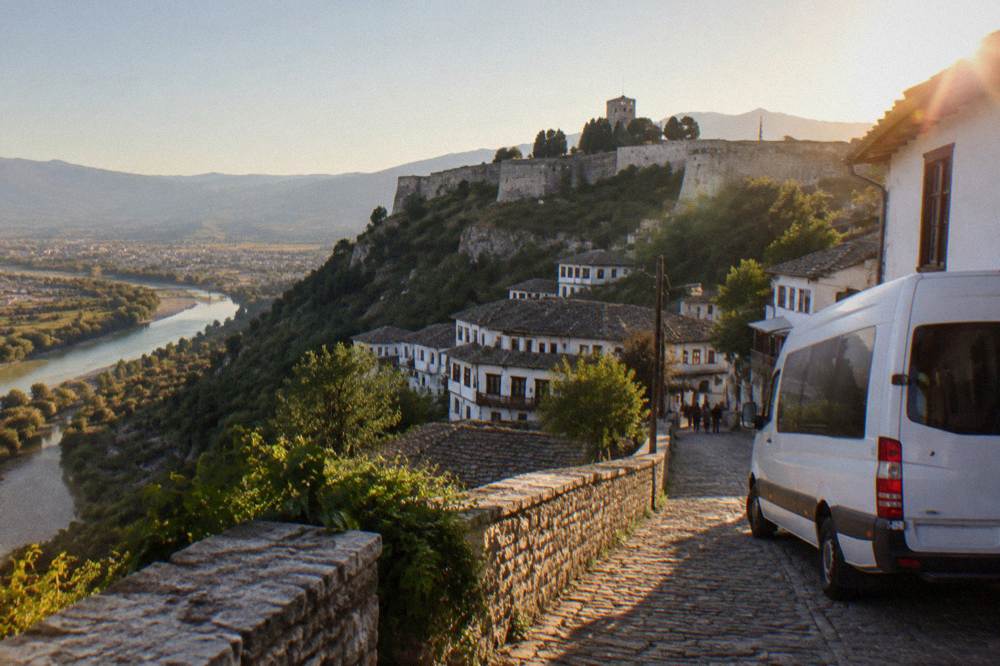
How Reliable Are Buses In Albania?
Albanian buses and furgons are reliable in practice but informal in form: they depart from set terminals, run roughly hourly on major routes through the day, and almost always show up. Delays of fifteen to forty minutes are normal rather than exceptional, timetables are spoken rather than published, and the system runs on cash. For a town like Berat the practical failure rate is low, and the main risk is not a missing bus but a missed last departure.
That distinction matters. Reliability in Albania is not the Swiss kind, where a screen tells you the platform two months ahead. It is a folk system: the drivers know the schedule, the ticket sellers know the schedule, hotel owners know the schedule, and the information reaches you through a person rather than a website. On major corridors, such as the Tirana to Berat run, departures are frequent enough through the day that even a wrong assumption costs you an hour at most, not a day.
The informality has a second edge that works in your favour. Because there is no advance reservation system on most routes, a bus cannot be sold out from under you before you arrive at the terminal. You buy your seat when you board or just before, in cash, in lek. The flip side is that you should not build a tight connection, say a bus landing you in Tirana forty minutes before an international flight, on a system where the timetable is a conversation. Leave margin and the system serves you well.
A note on words: in Albania a "furgon" is a shared minibus, typically eight to fifteen seats, that leaves when it is full or near full. Long-distance routes like Tirana to Berat use a mix of larger coaches and furgons depending on the operator and the time of day. For planning purposes you can treat them as the same thing: a vehicle with a set destination, a set terminal, and a departure time that bends.
What Does Dependable Look Like On The Tirana To Berat Route?
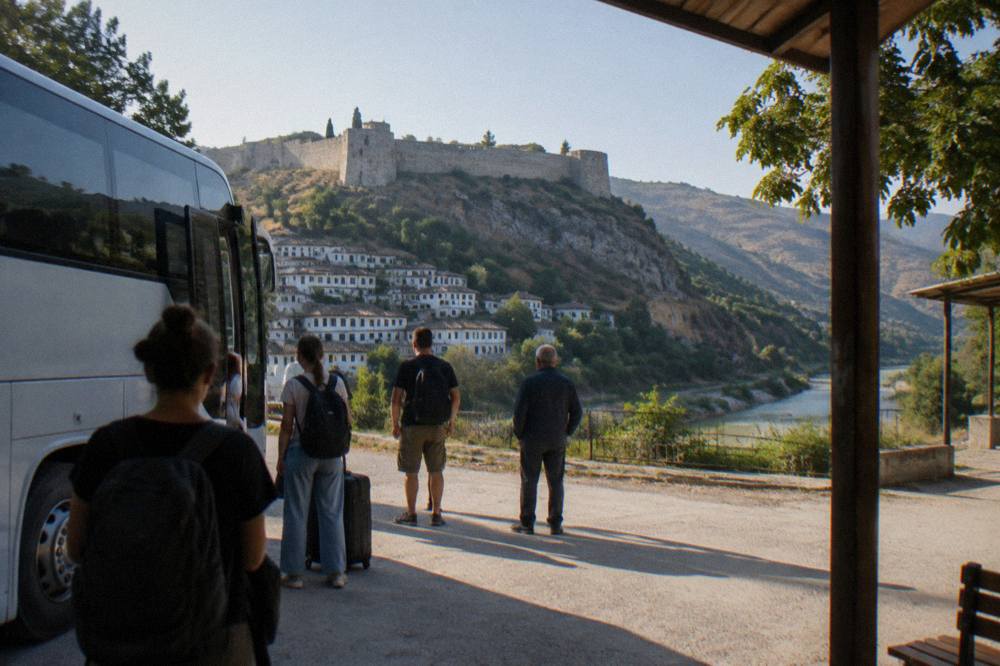
The Tirana to Berat route is the best test of Albanian bus reliability because it is frequent, paved the whole way, and takes about two and a half hours in each direction. Buses and furgons leave from Tirana's South-North terminal, run roughly hourly from early morning to late afternoon, and the fare is a few hundred lek paid in cash on board. Berat's own terminal sits on the SH72 on the edge of town, from where the old centre is a short taxi or local ride away.
This is the route most visitors to Berat actually ride, and it behaves like a commuter corridor rather than a frontier adventure. The run between Tirana's Terminali Jug-Veri and Berat takes about two and a half hours on a normal day, and the road is paved for its entire length. Departures are spread from the early morning through the late afternoon, roughly one an hour, which means you do not need to chase a single morning bus the way you might on a thinner route into the mountains.
| Route fact | What to expect |
|---|---|
| Departure point in Tirana | South-North terminal (Terminali Jug-Veri) |
| Journey length | About 2.5 hours each way |
| Frequency | Roughly hourly, early morning to late afternoon |
| Fare | A few hundred lek, paid in cash |
| Booking | None needed on most departures; pay on board |
| Arrival point in Berat | Bus terminal on the SH72, edge of town |
The fare deserves a sentence of its own because it is where newcomers get caught. It is paid in cash, in Albanian lek, either to a conductor walking the aisle or at a small booth at the terminal. Cards are not part of this system. If you arrive in the country with only a bank card and euros in your pocket, you will need lek before your first bus ride, and the honest advice is to get it from a bank ATM rather than a standalone machine on a tourist street. Roughly ninety-two lek makes one euro, so a few hundred lek is a modest sum by any budget, and prices in Albania generally remain kind to visitors, a subject covered in detail elsewhere on this Berat Travel Guide.
Luggage goes in the hold beneath the coach or, on a furgon, wherever it fits. Drivers handle loading themselves and expect a tip of nothing; it is simply part of the service. Keep your day bag with you, because on a full furgon your larger pack may end up under a seat or behind the last row, and you will want your valuables on your lap when the vehicle stops in a town en route.
If you would rather not work out the terminal, the cash and the arrival-point logistics on your own, a guided day trip from Tirana is a legitimate alternative, and several run on the same corridor. The trio below covers the three most useful shapes of that idea: a classic Berat day tour from the capital, a photography-focused night tour of the same city, and a canyon adventure for the day you want something wilder.
Each of those options puts the driving, the timing and the castle logistics in someone else's hands, which is precisely the part of Albanian bus travel that confuses first-timers. The classic day tour pairs well with the question of how many days to spend in Berat, which is worth deciding before you book anything.
Where Do Buses Actually Leave From And Arrive?
In Tirana, buses to Berat leave from the South-North terminal, not from a street stop, and you should budget time to reach that terminal from wherever you are staying. In Berat, the bus terminal sits on the SH72 on the outskirts, roughly a fifteen to twenty minute walk or a short taxi ride from Mangalem and the Gorica side of the old town. Both terminals are functional places with vehicles and ticket windows, not scenic ones.
The Tirana detail matters most for airport arrivals. There is no direct bus from Tirana's airport to Berat; the journey is always airport to Tirana, then across or through the city to the South-North terminal, then Berat. Build that transfer into your plan rather than assuming a single vehicle will carry you the whole way. In Berat, arriving at the terminal on the edge of town is a mild annoyance rather than a problem: the walk into the centre is along ordinary streets, and a taxi costs only a few euros by local standards, so neither option hurts.
Once you are inside Berat itself, the bus question mostly disappears. The old-town core, the castle quarter of Kala, Mangalem below it, and Gorica across the river, is compact and walkable, and everything a visitor wants to see on a first trip sits within an easy stroll of everything else. No one takes a city bus between the Gorica Bridge and the castle gate. Car access into the castle quarter is being restricted in any case, with barriers and parking controls being implemented to prioritise pedestrians, so walking is not just the cheap option but the intended one.
For day trips out of Berat, buses exist toward other towns, but they thin out fast outside the main corridors, and destinations like the Osumi Canyon around Çorovodë are served by occasional furgons rather than a steady rhythm. That is where the reliability question changes shape: the system is dependable between cities and genuinely sparse toward rural attractions, and travellers who want the canyon, waterfalls or wineries usually go with an organised tour instead. If you are weighing a rental car against that sparsity, the honest comparison is laid out in is it a good idea to rent a car in Albania, and the fuller case for slow travel without one is in where to go in Albania for the first time.
What Can Go Wrong, And What Should You Do About It?
The three realistic failure modes are a missed last departure, a full furgon at peak season, and an information gap, in that order of likelihood. Buses stop running in the late afternoon, so the dangerous mistake is scheduling a late arrival expecting an evening bus. A full vehicle means waiting for the next one, roughly an hour on the Tirana route. The information gap is solved by asking, and asking works.
| Scenario | What actually happens | Sensible response |
|---|---|---|
| You arrive at the terminal mid-afternoon | Departures continue, roughly hourly, into the late afternoon | Have lek in cash; buy on board |
| The furgon is full | It leaves, and you wait for the next one | Build an hour of slack into arrival plans |
| You reach Tirana in the evening hoping for Berat | The day's departures are finished | Overnight in Tirana or take a guided tour next morning |
| You ask a local about the schedule | You get the correct answer, usually within two tries | Ask at your accommodation the night before |
The late-afternoon cutoff is the single most important reliability fact on this page, and it deserves its own paragraph because it is the one that strands people. Albanian interurban buses are a daytime system. If your flight lands at Tirana's airport in the evening, the buses to Berat have already stopped for the day, and no amount of determination changes that. The correct plan is a night in Tirana and a morning departure, which also happens to be a pleasant plan, since the capital rewards an evening.
The information gap sounds scarier than it is. Because schedules live in people's heads, your first instinct should be to ask, and the second person you ask is usually more accurate than the first. Hotel and guesthouse hosts in Berat deal with these questions daily and will tell you honestly when to leave, where to stand, and what to pay. This is also the honest answer to whether the country is hard to travel in generally: it is not hard, it is just person-powered, and travellers who treat conversation as their timetable app do fine.
Seasonality bends things a little. In the height of summer, when tourist traffic into Berat swells, furgons fill faster and the "wait for the next one" scenario becomes more common, and in the depth of winter, departures thin out and roads over the interior can be slow after bad weather. Neither is a crisis. Both reward the same habits: lek in cash, an hour of slack, and no evening arrivals.
Should You Take A Bus Or A Guided Tour To Berat?
Take the bus if you are staying overnight in Berat, travelling on a normal daytime schedule, and happy to handle cash and terminals; it is cheap and it works. Take a guided tour if you are on a day trip from Tirana, want the castle explained rather than just reached, or are connecting from an evening flight the night before. The bus is transport, the tour is transport plus a guide plus fixed timing.
The economics are not really the deciding factor, because both are modest by the standards of most of Europe. What decides it is your appetite for logistics. A bus deposits you at Berat's terminal with the whole day ahead of you and no structure at all, which is perfect for anyone staying the night and exploring at their own pace. A tour collects you in Tirana, walks you through the castle and the old quarters with someone who can explain what you are looking at, and returns you in the evening, which converts a full day into something with zero overhead.
The guided option has one shape that suits photographers and slow travellers especially well: a night-focused tour of Berat from Tirana, timed so that you see the thousand-windows old town in the evening light rather than at midday. If the sight of Mangalem's white houses stacked up the hillside at dusk is the reason you are going, that timing is worth paying for.
For the daytime classic, the Berat day tour from Tirana remains the workhorse choice, and its price and current rating sit on the live listing rather than in this prose. It is the format to pick when you want the castle, the views over the Osum, and the story of the town delivered in one packaged day.
One honest caveat on tours, because this page is about reliability and honesty travels with it: a tour shifts the dependency from a bus system to an operator, so the same advice about margin applies. Book the day after an evening arrival, not the same evening. Everything else, the driving, the guiding, the timing, is then someone else's reliability problem, which is exactly what you are buying. If the cost question is what holds you back, the broader picture is in is Albania cheap or expensive.
Common Questions About Buses In Albania
How reliable are buses in Albania?
Albanian buses and furgons are reliable in practice: they run from set terminals, roughly hourly on major routes like Tirana to Berat, and they show up. The system is informal, cash-based and light on published timetables, so reliability here means frequent departures and helpful locals rather than printed schedules.
How do you get from Tirana airport to Berat?
There is no direct airport bus. You travel from the airport into Tirana, then to the South-North terminal, then by bus or furgon to Berat, about 2.5 hours on the final leg. Evening arrivals should plan a night in Tirana, because the day's departures to Berat finish in the late afternoon.
Do you need to book Albanian buses in advance?
Usually not. Most departures, including Tirana to Berat, are paid in cash on the day, and seats cannot be reserved ahead on most routes. In peak summer a furgon can fill up, in which case you wait for the next departure, roughly an hour later.
Can you pay for Albanian buses by card?
No. Buses and furgons take cash in Albanian lek, paid to a conductor or at the terminal booth. Euros are not the local currency, and change is usually given in lek, so withdraw lek from a bank ATM before travel day.
Is there a train to Berat?
No passenger train reaches Berat. Albania's railway network is limited, and the Tirana to Durrës line is under reconstruction with a target of end-2027, so buses, furgons and guided tours are the realistic ways in.
Where does the bus arrive in Berat?
At the bus terminal on the SH72, on the edge of town. From there it is roughly a fifteen to twenty minute walk or a short taxi ride to Mangalem, Gorica and the old centre, all of which are then comfortably explored on foot.