What Is Albania Famous For?
Albania is famous for its UNESCO Ottoman hill towns like Berat, the Osumi Canyon, native Shesh and Puls wines, raki, and the Bektashi pilgrimage on Mount Tomorr. A full answer, written from Berat.
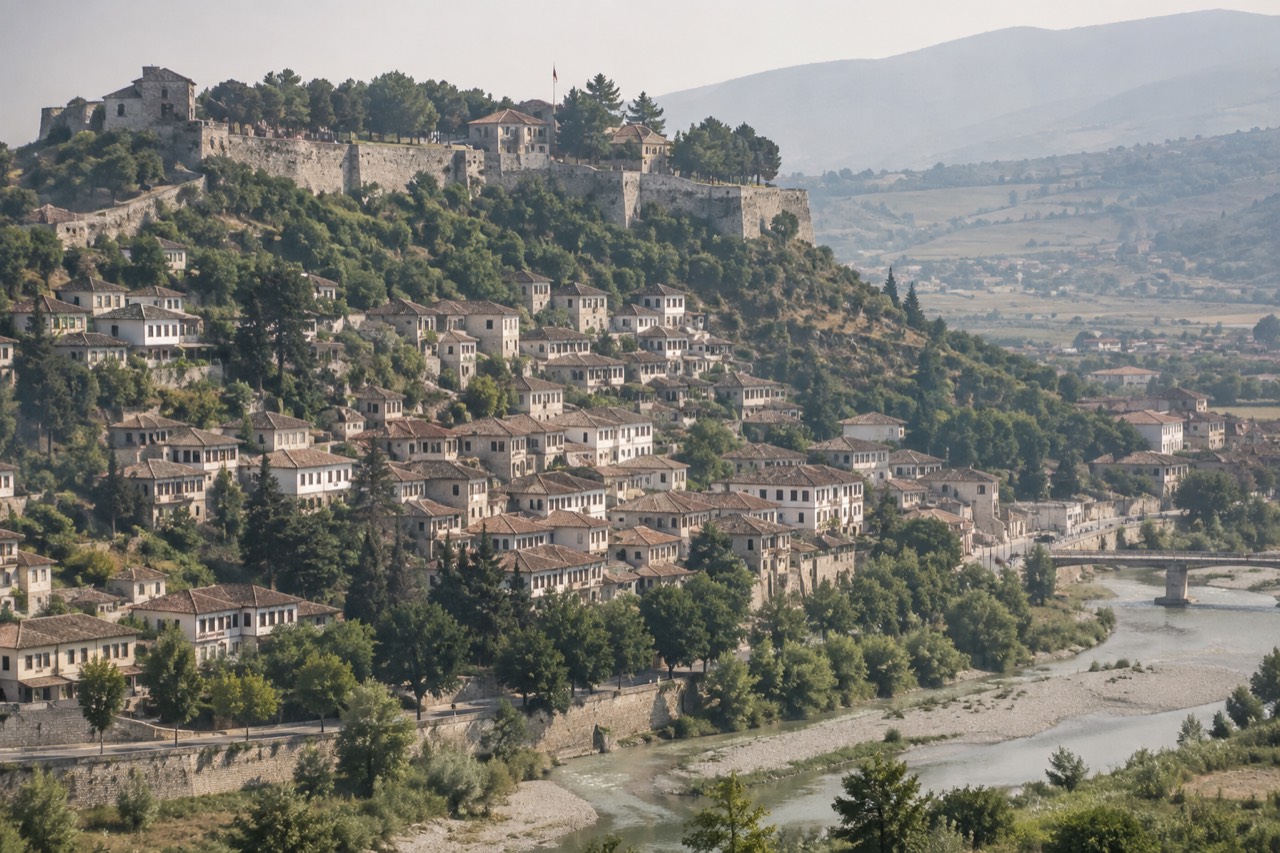
Ask what Albania is famous for and the honest answer starts with one town: Berat, the UNESCO World Heritage Ottoman-era hill town in central Albania, stacked above the Osum River in a fan of white windows that has earned it the nickname "City of a Thousand Windows". Around it sit the other things the country is known for, the Osumi Canyon in the Skrapar hills, the holy mountain of Tomorr, a table of lamb, byrek and raki, and wine grapes that grow almost nowhere else on earth. Albania is also talked about for its price level, one of the lowest in Europe, and increasingly for its Riviera beaches far to the south, though Berat itself is entirely inland, a river town with no coast and no tide.
What Is Albania Famous For?
Albania is famous for its UNESCO-listed Ottoman hill towns, above all Berat in central Albania, for the Osumi Canyon and the adventure trade it feeds, for Mount Tomorr and its August Bektashi pilgrimage, for native Shesh and Puls wine grapes and strong raki, and for being one of the most affordable countries in Europe. The "City of a Thousand Windows" image, Berat's white houses climbing toward its castle, is the single most shared view of the country.
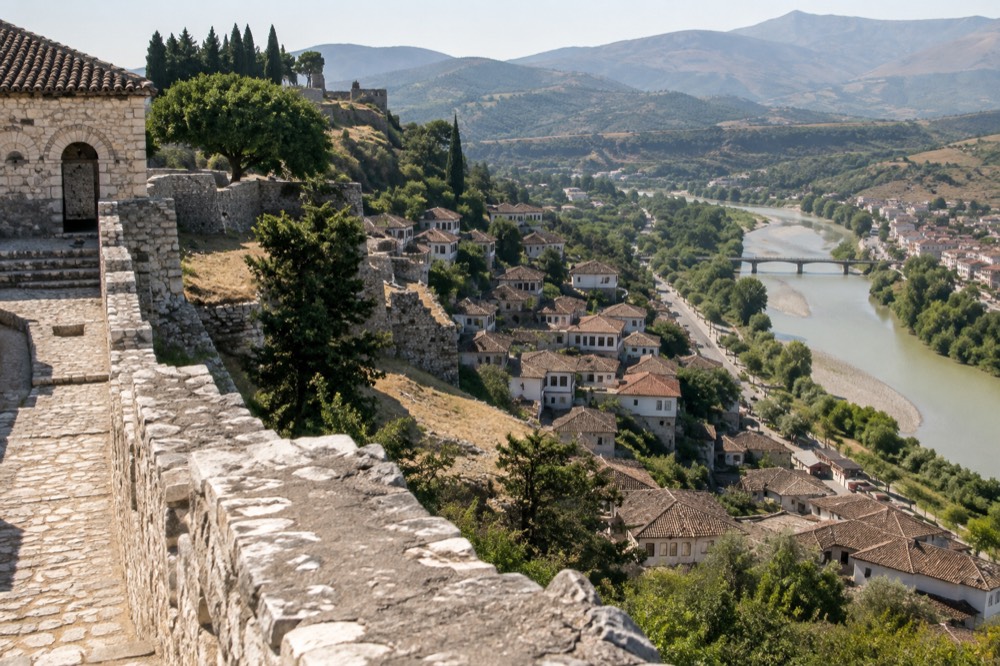
That image is not marketing. UNESCO inscribed the historic centres of Berat and Gjirokastra as one World Heritage property, with Gjirokastra listed in 2005 and Berat added in 2008, and describes Berat as "a rare example of a well-preserved Ottoman town". The property covers 58.9 hectares with a 136.2-hectare buffer zone, and the castle above Mangalem still carries 24 defensive towers on its walls. If you want the deeper backstory of the town itself, our piece on what Berat is famous for goes site by site.
But Albania's fame is wider than one town, and the fastest way to see the spread is a table rather than a paragraph.
| What it is famous for | The signature | Where the proof is |
|---|---|---|
| Ottoman hill towns | Berat's thousand-window hillside, Gjirokastra's stone roofs | UNESCO World Heritage list, property 569, Berat added 2008 |
| River canyons | Osumi Canyon near Çorovodë, a protected natural monument | Skrapar region, roughly an hour to an hour and a half from Berat on paved roads |
| Holy mountains | Mount Tomorr, 2,416 m at Çuka e Partizanit | Tomorr National Park, visible from Berat's castle walls |
| Native wine grapes | Shesh i Zi, Shesh i Bardhë and the rare Berat-area white Puls | Cobo Winery and the Roshnik valley wineries around Berat |
| August pilgrimage | Bektashi journey to the tomb of Abaz Ali on Tomorr | The 2026 edition ran 18 to 25 August |
| Low costs | Restaurant meals are cheap by European standards | Towns like Berat, where the old town is still largely cash |
One frame that rarely makes the shortlists: Albania is famous among travellers for changing faster than guidebooks can keep up with. The country is an EU candidate in accession negotiations, all negotiating clusters opened by late 2025, yet it is not an EU member and not in the Schengen area, so a visit to Berat is not a Schengen crossing and days in Albania do not count toward any Schengen allowance. That in-between status, European geography, non-EU paperwork, is part of what makes the place feel different.
The City Of A Thousand Windows
Berat is Albania's single most famous view: a hillside of white Ottoman houses whose rows of windows stacked above the Osum River gave the town its thousand-windows name. The upper town is a real castle quarter, Kala, with walls carrying 24 towers, churches and a lived-in community inside, inscribed by UNESCO in 2008 as part of the Historic Centres of Berat and Gjirokastra. Most first-time visitors see it on a day trip and wish they had stayed a night.
The town splits into three old quarters: Mangalem on the castle slope, Gorica across the river, and the Kala at the top. About 42 churches once stood inside the castle walls and around eight are preserved today, alongside the Red Mosque, among the earliest Islamic buildings in the fortress. Down the slope, the Onufri Iconographic Museum inside the Church of St Mary holds the icons of Berat's greatest painter, and the Ethnographic Museum reopened on 30 May 2026 after three years of restoration with roughly 1,300 objects on display. The museum pair draws serious crowds now: Onufri counted 58,912 visitors from January to July 2026, up 16 percent on the same period the year before.
If you are arriving from the capital, the classic way to see all of this in one day is a guided round trip, and the strongest options compare well against each other.
Those trips matter because Berat rewards context. The town bears, in UNESCO's own words, "the imprint of a more independent life style, linked to its handicraft and merchant functions", and that mercantile character is still visible in the bazaar-era lanes below the castle. Whether a single day is enough is a real question with a real answer, and we treat it properly in how many days you should spend in Berat. For the fence-sitters, there is also a longer verdict in whether Berat is worth visiting.
Osumi Canyon And The Adventure Season
Albania is famous among adventure travellers for the Osumi Canyon, a protected natural monument carved by the Osum river near Çorovodë in the Skrapar region, with sheer walls, cold water and seasonal rafting and tubing. Operators run rafting in spring when snowmelt fills the canyon, roughly March to early or mid June, then switch to tubing and swimming through summer and autumn. There is no entrance fee to view the canyon from the rim.
The seasonal switch is the detail most visitors miss. Spring water makes the canyon a whitewater trip; summer water makes it a float. The rim viewpoints, including the opening known as Vrima e Nuses and the old Italian bridge, are free to walk to, and the drive from Berat to the Çorovodë area takes one to one and a half hours on fully paved roads. The closest swimming-with-a-viewpoint combo is Bogove waterfall in Tomorr National Park, reached on a short forest walk from the village of Bogovë.
The tubing side of the canyon is exactly what it sounds like: you sit in a ring, the river carries you, the walls go up. The Original Osumi Canyon River Tubing Tour is the longest-running version of that trip, and you can check current dates and pricing on the operator's live listing: Check availability. Trips from Berat typically bundle the canyon with Bogove waterfall and a village lunch, which suits a hot afternoon better than a castle climb.
Is the canyon the reason to come? For many summer visitors it is second only to the castle, and the season table below is the practical answer to the question everyone actually asks: when can I do it?
| Canyon activity | Rough season | Why then |
|---|---|---|
| Rafting | Early March to mid June | Snowmelt keeps water levels high enough for paddling |
| Tubing and river swimming | Mid June into autumn | Water is lower, calmer and warmer for floating |
| Rim viewpoints | Year-round | Free to visit; the drive is on paved roads throughout |
Wine, Raki And The Albanian Table
Albania is famous for a food and drink tradition built on raki, the grape or fruit spirit offered to guests, and on wine from native grapes: Shesh i Zi for red, Shesh i Bardhë for white, and Puls, a rare white variety grown in the Berat area. Around Berat, family wineries such as Cobo in the Roshnik valley pour these alongside olives, cheese and slow-cooked lamb dishes like tavë kosi. A festival in Berat each October, Wine and Stories, pours them all under one roof.
The Berat table has its own signature dishes beyond the national ones. Qifqi, rice dumplings with mint and fennel, belong to Berat specifically. Japrak, stuffed grape leaves, and tavë kosi, lamb baked under yogurt and egg, appear everywhere in the region, at spots locals name first, from Homemade Food Lili to Restaurant Klea. Raki arrives unasked, usually before you have finished ordering, and a shot typically costs around two euros; a gentle read on Albanian drinking culture more broadly is in our answer on whether Albanians drink alcohol.
The wine scene deserves more attention than it gets. Cobo Winery works with the indigenous varieties of the region, including Vlosh and Puls, the latter also used for a traditional-method sparkling wine aged 36 to 40 months on its lees. The Roshnik valley wineries, Alpeta, Luani, Nurellari, Edoni and Pupa among them, sit within a short drive of the old town, and a guided tasting with transfers spares you the mountain roads. The Wine and Stories of Berat festival ran 2 to 4 October in 2026 with wineries from Albania and Kosovo; the wider festival calendar is covered in Albania's famous festivals.
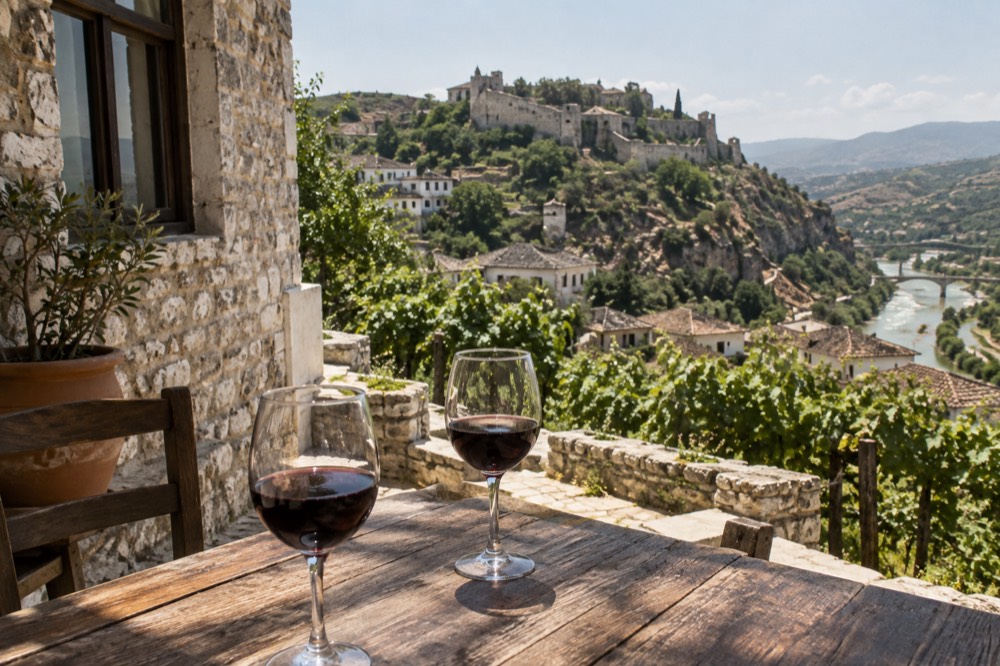
A guided winery visit with transfers and tastings is the relaxed way to sample all of this, and the operator's live listing has current departure times.
Prices are part of the fame too, honestly the loudest part. Eating out in Berat is cheap by European standards, so carry cash in lek. Treat all of those as planning ranges and confirm at the table or the front desk, since Berat's old town is largely a cash economy in lek. The full budget picture, including how the lek behaves against the euro, is in our is Albania cheap or expensive breakdown; the short version is that at roughly 92 lek to the euro, dinner for two costs what a single main does in most of western Europe.
Mount Tomorr And The Bektashi Pilgrimage
Albania is famous for Mount Tomorr, a 2,416-metre holy mountain in a national park that rises over the Berat region, and for the Bektashi pilgrimage to the tomb of Abaz Ali at its top each August. The 2026 pilgrimage ran from 18 to 25 August with police-managed traffic around the Kulmak Tekke. The park itself protects brown bear, wolf and birds of prey, and its fir forests and glacial lakes are a growing draw for hikers.
Tomorr is the spiritual counterpart to Berat's stones. The pilgrimage is one of the largest religious gatherings in the Balkans, and pilgrims climb to the türbe on the southern peak in late August every year, walking or riding up roads that were rebuilt in 2026 to shorten the drive to the shrine. For non-pilgrims, the mountain is simply the biggest skyline object in the region, with marked trails, waterfalls such as Sotira, and cooler air when the town below is baking, since summer heat in Berat can top 40 °C, as it did on 20 July 2026, reported as the hottest day of the year with the highest values recorded in Berat.
Practical note for an August visit: the pilgrimage week brings road restrictions and crowds around Kulmak, so check the local traffic notices if you plan to drive up then. The rest of the year the park is quiet, and hikes around Berat in general are covered in our trail guide.
Fires are a real summer caution in the region; a February 2026 forest fire in Tomorr park burned before it was contained, and summer 2025 saw a large fire on nearby Mount Shpirag. None of that closed the park, but it explains the seasonal burning bans you may see posted.
Common Questions About Albania's Famous Sights
What is Albania famous for?
Albania is famous for its UNESCO-listed Ottoman hill towns, above all Berat with its thousand-window hillside, for the Osumi Canyon, for Mount Tomorr and its August Bektashi pilgrimage, for raki and native Shesh and Puls wine grapes, and for being one of the most affordable countries in Europe.
Is Albania part of the European Union or the Schengen area?
No to both. Albania is an EU candidate country in accession negotiations, but it is not an EU member and not in the Schengen area. A visit to Berat is not a Schengen crossing, and days spent in Albania do not count toward any Schengen 90-day allowance. UK and EU citizens can stay visa-free for 90 days in any 180-day period; US citizens can stay up to a year without a residency permit.
What food and drink is Albania known for?
Raki, the spirit offered to guests; wine from native grapes such as Shesh i Zi and the rare Berat-area white Puls; tavë kosi, lamb baked with yogurt; japrak, stuffed grape leaves; and qifqi, Berat's own rice dumplings with mint and fennel. A cheap restaurant meal in Berat is famously gentle on the wallet.
Which is the most famous town in Albania?
Berat is the most photographed and the one UNESCO calls "a rare example of a well-preserved Ottoman town". Gjirokastra, its stone-roofed partner in the same World Heritage listing, runs it close, and the comparison between the two is a genuine traveller debate covered elsewhere on this site.
Is Albania expensive?
No. It is one of the cheapest countries in Europe. Berat is cheap by European standards, and cash in lek is the way to go. Costs have crept up as tourism grows, but value remains a core part of the country's reputation.
What is the best month to visit?
Shoulder months are the most comfortable: spring for canyon rafting on snowmelt, early summer and autumn for tubing, hiking and the October wine festival in Berat. Midsummer brings heat that can top 40 °C in Berat, plus the busiest castle crowds of the year.
Between the castle, the canyon, the table and the holy mountain, the trio below covers the three experiences Albania is most famous for, all bookable in one stay.
Whichever of those you pick, the reason they exist at all is the one this Berat Travel Guide keeps returning to: a small, cheap, deeply traditional country where the most famous things, a hill of windows, a river in a gorge, a glass of raki, are still close enough together to fit into a single trip.