What Is The Nicest Part Of Albania?
The nicest part of Albania is Berat, the UNESCO World Heritage Ottoman hill town on the Osum River, with its castle, white Mangalem houses, Gorica quarter, and easy reach to Tomorr and Osumi Canyon.
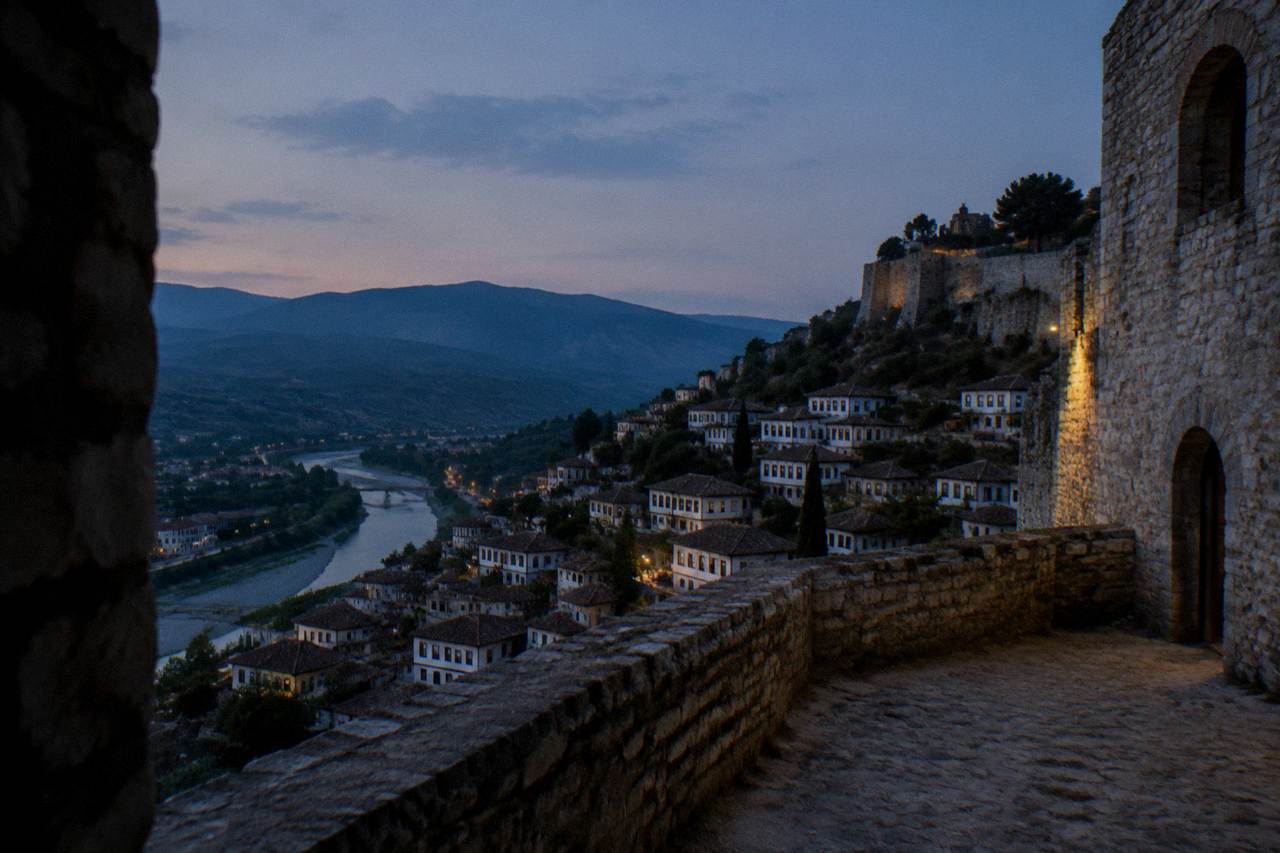
Most travellers who have seen a fair slice of Albania give the same answer quietly, a few days into the trip: Berat. This is a UNESCO World Heritage Ottoman-era hill town in central Albania, built on the banks of the Osum River, and it is the one place in the country where the landscape, the architecture and the everyday life of a working town all hold together in a single view. The white houses of Mangalem climb the hillside in rows of oversized windows, a castle keeps watch above them, and the Gorica quarter mirrors the whole scene from the far bank. Berat is inland, there is no coast here, and that is part of why it feels different from the beach towns on the Riviera. This guide sets out why Berat earns the title of the nicest part of Albania, what the figures behind that claim actually are, and how to build a visit around it, with help from a few planned stops at tours worth considering.
What Is The Nicest Part Of Albania?
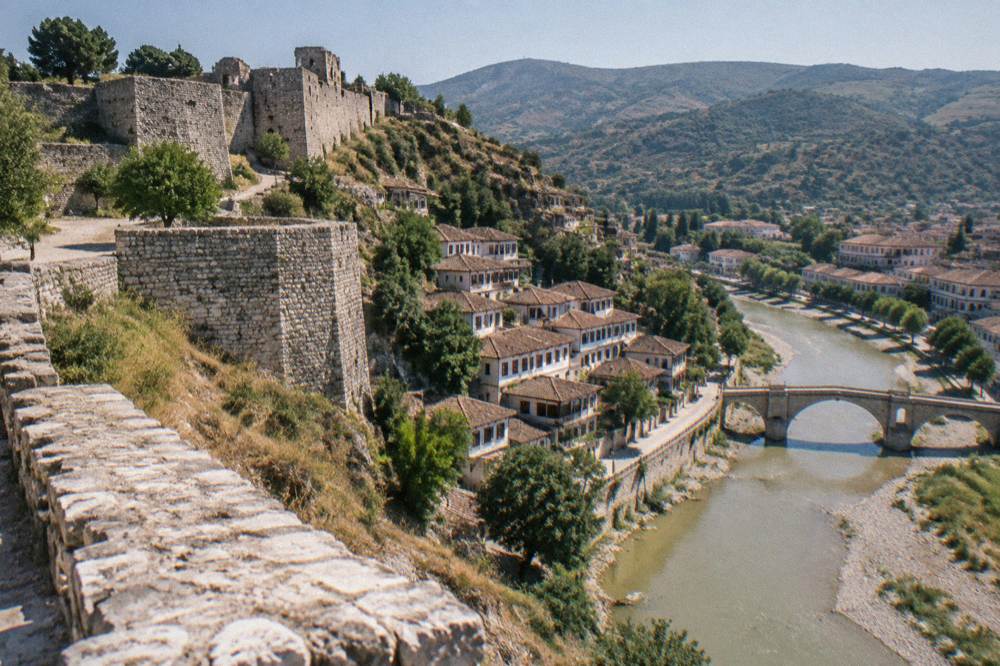
The nicest part of Albania is Berat, a UNESCO World Heritage Ottoman-era hill town in central Albania on the Osum River, inscribed in 2008 as an extension of the Historic Centres of Berat and Gjirokastra. UNESCO itself calls it a rare example of a well-preserved Ottoman town. Its castle quarter, Mangalem windows, Gorica bridge and river views make it the single most rewarding base in the country.
That is not just a local boast. The UNESCO listing covers 58.9 hectares of protected property with a 136.2 hectare buffer zone, shared with Gjirokastra, and the reason the town earned it is visible from any rooftop in Mangalem. Some 42 churches once stood inside the castle walls; about eight are preserved today, alongside 24 defensive towers and the Red Mosque, among the earliest Islamic buildings in the fortress. The Kala, as the castle quarter is called, is not a museum shell. People live inside it, guesthouses operate within the walls, and a centuries-old building next to the Onufri Museum is being converted into an eight-room family guesthouse under the 2025 National Investment Scheme. Few World Heritage towns anywhere are still this lived-in.
Berat also sits at the centre of the country's best cluster of short excursions. Mount Tomorr rises to 2,416 metres at Çuka e Partizanit within the Tomorr National Park, the Osumi Canyon snakes through Skrapar under an hour and a half away, and the Bogovë waterfall is a short forest walk from the village of the same name. For planning around those distances and timings, the guide to how long it takes to walk up to Berat Castle covers the climb that most visitors make on their first afternoon.
What seals it, though, is scale. The municipality counted 62,232 residents at the 2023 census, small enough that the old town never feels like a theme park, and Berat prefecture recorded the smallest population decline of Albania's declining prefectures between 2011 and 2023, just 0.7 percent. The town is stable, quiet and genuinely Albanian, which is a harder combination to find on the coast in August.
Why Berat Beats The Coast And The Capital
Berat beats the Albanian coast and Tirana for visitors who want beauty, history and value in one walkable place, because its Ottoman old town is UNESCO-listed, its museums cost a few hundred lek, and its guesthouses sit inside the historic fabric itself. The coast offers swimming; Tirana offers restaurants and museums; Berat offers both a landscape and a living heritage site.
Start with the economics of a day in Berat. The Onufri Iconographic Museum, inside the castle, charges 400 lek for an individual ticket, with an audio guide at 500 lek, reduced entry at 200 lek, and ages 12 to 18 or students at 120 lek. Children under 12 enter free. The Ethnographic Museum, which reopened after more than three years of restoration with roughly 1,300 objects on display, charges 300 lek individual, 150 lek reduced, 90 lek for ages 12 to 18 and students, and is free for under-12s. These are museum prices from another decade, and they buy two of the better small museums in the Balkans. The museums open 9:00 to 18:00 daily from 1 May to 30 September, and Tue-Sat 9:00 to 16:00, Sun 10:00 to 15:00 from 1 November to 30 April, with free entry days on 18 April, 18 May, 21 May and 29 September.
The Onufri Museum is not a sideshow either. It drew 58,912 visitors over the first seven months of the year, up 16 percent on the 50,615 recorded for the same months a year before, with May the busiest month at more than 17,000, and about 14,000 in August alone, roughly 4,000 more than the same month the previous year. Crowds are arriving, but the town absorbs them across a wide hillside rather than funnelling them down one street.
| Museum | Individual | Reduced | Ages 12-18 / Students | Children Under 12 | Audio Guide |
|---|---|---|---|---|---|
| Onufri Iconographic Museum | 400 ALL | 200 ALL | 120 ALL | Free | 500 ALL |
| Ethnographic Museum | 300 ALL | 150 ALL | 90 ALL | Free | Not listed |
Compare that with what the coast gives you in high summer. The Riviera in July is hot, crowded and, by recent reporting, sharply more expensive, with accommodation and services across Albania rising 6.5 percent and tourism-linked sectors driving the majority of late-2025 price increases, while sharper spikes hit the coastal strip. Berat and Gjirokastra saw only modest increases. Summer heat is real here too, and it can top 40 °C, but the old town's stone lanes stay usable in the mornings and evenings in a way a treeless beach cannot match. For working out the timing, the page on the best month to visit Berat is the deeper dive.
Tirana, meanwhile, is a capital city doing capital things: traffic, cafés, a few strong museums, and a pace that belongs to the country rather than to travellers. It is the transit hub, since buses and furgons to Berat leave from the South-North terminal with roughly hourly departures across the day, but almost nobody describes the capital itself as the nicest part of Albania. Berat is where people take photographs they keep. You can read the fuller argument in is Berat Albania worth visiting.
The one honest caveat is access. There is no direct airport bus from Tirana's airport to Berat; you change at the terminal in the city. There is also no passenger train to Berat at all, since the Tirana-Durrës line is under reconstruction with a target around the end of 2027, and the Durrës-Rrogozhinë tender winner was not expected before November 2026. Buses are the way in, and they work.
How Berat Compares With Albania's Other Favourite Towns
Albania's other headline destinations, Gjirokastra, Shkodër, Krujë and the southern coast, each beat Berat on one single thing: Gjirokastra on drama, Shkodër on lakes, the coast on swimming. None of them combines a UNESCO old town, a river setting, a lived-in castle and the range of nearby mountains and canyons the way Berat does, which is why it keeps the crown.
Be careful with numbers here, because this build verified figures only for Berat. Every figure quoted on this page is Berat's own; no comparable statistic was sourced for the other towns, and inventing one would be exactly the kind of travel-guide noise this site exists to avoid. So the comparison runs on character, which a reader can check standing in the street. Everything else covered here is indexed on Berat Travel Guide.
Gjirokastra is Berat's World Heritage sibling, inscribed first in 2005, with Berat added in 2008 as an extension of the same property. It is a stone-roofed fortress town steeper and greyer than Berat, more dramatic per square metre, and it pairs well with Berat rather than competing with it; the drive between them is one of the country's better road trips. The honest trade is that Gjirokastra feels more like a monument and Berat feels more like a town where people hang washing between the monuments. If you are choosing between them, the comparison piece on Gjirokastra or Berat works through it question by question.
Shkodër, up north, is a lakes-and-cycling city near the Montenegrin border, a different mood entirely, better as a base for Theth and the Albanian Alps. The southern coast, Sarandë and Ksamil, is where the Instagram version of Albania lives, but recent reporting flagged it as the part of the country where prices rose fastest. What Berat offers that none of these can is the view from the Gorica Bridge across the Osum at dusk, with Mangalem lit on one side and the castle above, which is the single most photographed scene in the country, and it costs nothing to stand there.
There is a regional argument too. Berat sits at the centre of a triangle: Tomorr to the east, Osumi Canyon to the south-east near Çorovodë, and the wineries of the Roshnik hills to the south. The Berat region grows Shesh i Zi and Shesh i Bardhë, the native central Albanian grapes, plus Puls, a rare local white that Cobo Winery ferments into a traditional-method sparkling aged three years and more on its lees. A wine country with a fortress town attached is a rare thing in Europe at these prices, and the Berat wineries guide lays out the estates.
For the country-level picture, including whether the whole place suits a first trip, see where to go in Albania for the first time.
The Best Things To Do Around Berat
The best things to do around Berat are the castle walk with its 24 towers, the Onufri and Ethnographic museums, the Gorica quarter across the river, a winery visit in the Roshnik hills, and a day trip into Osumi Canyon or up Mount Tomorr, all reachable from a base inside the old town in under ninety minutes.
The castle walk is the anchor. The walls carry 24 defensive towers and enclose a residential quarter with churches, the Red Mosque and guesthouses, and the views west over the Osum valley are the reason people climb. Vehicle access into the Kala is restricted to residents, pre-booked hotel guests, licensed taxis and a few other categories, so the assumption should be park below and walk up. The cobblestone approach road has also been under repair after earlier damage.
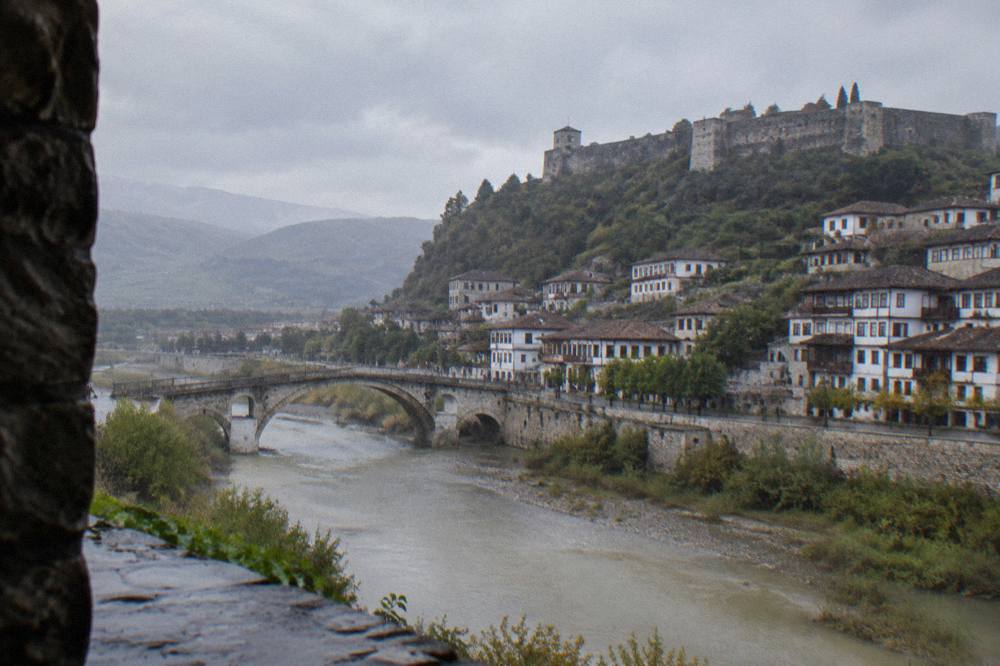
Below the walls, the river scene holds the rest of the day. The Gorica quarter across the old bridge is the quieter side of town, and its historic urban landscape was among the completed restoration projects listed in Albania's January 2026 UNESCO state-of-conservation report, alongside works in Mangalem, the Gorica castle trail and parking near the Old Gorica Bridge. A new 290-metre EU-funded panoramic bridge over the Osum now connects Bilçë and neighbouring villages to Berat and takes through traffic away from the historic centre, which is one reason the old streets feel calmer than they did.
| Excursion From Berat | What It Is | Verified Detail |
|---|---|---|
| Mount Tomorr | 2,416 m peak in Tomorr National Park | Annual Bektashi pilgrimage to the tomb of Abaz Ali, 18-25 August |
| Osumi Canyon | River gorge near Çorovodë, protected as a natural monument | No entrance fee to view the canyon from the rim |
| Bogovë waterfall | Forest waterfall inside Tomorr National Park | Short walk of roughly 30-60 minutes return from the village |
| Berat wineries | Roshnik-hill estates around the town | Home grapes: Shesh i Zi, Shesh i Bardhë, Puls |
Beyond town, the mountains take over. Mount Tomorr is sacred to the Bektashi community, and the pilgrimage of 18 to 25 August was expected to draw around 600,000 people to the tomb of Abaz Ali below the 2,416-metre peak, with police traffic restrictions around Kulmak Tekke; if your trip lands in late August, plan around it. The Berat-Ballaban road project was nearing completion in September 2026 with new asphalt, signage and barriers, and a new road to the holy peak has cut the drive to the shrine to roughly thirty minutes where it previously took an hour and a half to two. A guided trip such as the Explore Berat Mount Tomorr and Sotira Waterfall excursion covers the mountain and the falls with a local guide and equipment handled; Check availability on the operator's live listing if that fits your dates, since timings on the mountain depend on the season.
The canyon is the second big excursion. Osumi Canyon near Çorovodë is protected as a natural monument, and viewing it from the rim costs nothing; the drive from Berat is an hour to an hour and a half on fully paved roads to the Çorovodë area, with gravel deeper in. Rafting runs in spring, roughly March to May or June depending on snowmelt and water levels, and tubing takes over for the summer and autumn when the river calms. If you want to book one of those days rather than navigate it yourself, the selection below includes the best-reviewed options.
Closer to town, the food and wine half of Berat rewards an evening. A cooking class in a family home, a winery tour with transfers through the Roshnik hills, or simply dinner on a Mangalem terrace with the walls floodlit above: all three are Berat at its most pleasant. For the eating side, where to eat in Berat and what to eat in Berat are the site's dedicated guides, and the winery guide covers the estates pouring Puls and Shesh.
When To Visit Berat And How Long To Stay
The best time to visit Berat is spring or early autumn, when the summer heat has passed but the mountains and canyon are still in season; summer days can top 40 °C, and late August brings the Tomorr pilgrimage traffic. Two nights is the working minimum, three or four lets you add a canyon day and a winery afternoon without rushing.
On weather, only qualitative claims are safe: Berat has hot, dry summers and wetter winters, with rain peaking in the November to January window and July the driest month. No official station normals were verified for the town, so no monthly temperature table belongs on this page, and any site showing you one for Berat is estimating. What is certain is that summer heat in the town can top 40 °C, so treat peak summer with respect and do the castle climb before noon.
Season shapes the excursions as much as the town. Spring is rafting season on the Osum, with water levels highest after snowmelt. Summer belongs to tubing, swimming and the wine festival run-up: Wine & Stories of Berat runs 2 to 4 October, with Albanian and Kosovo wineries pouring, an oenologist-judged contest, and food stands around the old town, which makes early October a genuinely pleasant slot. Autumn also dries out the Tomorr trails after the August pilgrimage. If you are planning a whole Albania itinerary, the best month to go to Albania covers the country-wide picture.
On length of stay, the practical answer is that one day shows you the castle and the bridge and nothing else, and Berat rewards slowing down: a museum morning, a Gorica afternoon, a winery day and a canyon or mountain day stack comfortably into three nights. The site's two days in Berat itinerary is the template, and the question how many days to spend in Berat gets into the trade-offs.
Money is simple here. The currency is the Albanian lek, roughly 92 lek to the euro, and the old town runs largely on cash; cards work at some hotels and larger restaurants but Mangalem is cash territory, and ATM fees on foreign cards commonly run 500 to 800 lek, so withdraw at bank branches rather than stand-alone machines. Food and drink are cheap by European standards, and it is best to carry cash in lek. Those are planning ranges from recent price reports, and menus change, so treat them as orientation rather than promises. The Berat costs and money and currency in Albania guides carry the detail.
One last practical note that belongs to Berat and no other Albanian town on your list: emergency numbers in Albania are 112 for general emergencies, with ambulance 127, fire 128 and police 129 also cited. UK FCDO advice reports no travel warnings for any part of the country, and the US advisory sits at Level 2, exercise increased caution. Sensible care at night and on the roads is the whole of it, and the site's is Berat safe guide goes deeper.
If Berat is your answer to the nicest part of Albania, and it probably will be, the tours below are the three that fit the town best: the mountain and waterfall guide, a family-home cooking class in Çorovodë on the canyon road, and the classic UNESCO heritage and Belshi Lake day trip that brings you in from Tirana or Durrës in the first place.
Common Questions About The Nicest Part Of Albania
What is the nicest part of Albania?
Berat, the UNESCO World Heritage Ottoman hill town in central Albania on the Osum River. Its castle quarter, the windowed houses of Mangalem, the Gorica quarter across the bridge and the views over the Osum valley make it the most rewarding single stop in the country.
Is Berat nicer than Gjirokastra?
They share one World Heritage inscription, with Gjirokastra listed in 2005 and Berat added in 2008. Gjirokastra is steeper, greyer and more dramatic; Berat is greener, softer and still lived-in. Most visitors who see both prefer Berat for atmosphere and Gjirokastra for spectacle.
Is Berat expensive to visit?
No. Museum tickets run 300 to 400 lek, and meals and guesthouses are cheap by European standards, paid for in cash in lek. Berat saw only modest price increases where the coast saw sharp ones, and the old town is largely cash, so carry lek.
How many days does Berat need?
Two nights covers the castle, museums and both riverbanks. Three or four nights lets you add Osumi Canyon or Mount Tomorr and a winery afternoon without rushing.
What is the best month to visit Berat?
Spring and early autumn. Summer heat can top 40 °C, late August brings the Tomorr pilgrimage crowds to the region, and the Wine & Stories of Berat festival in early October makes that a pleasant window.
Do you need a car in Berat?
Not for the town itself. Buses from Tirana reach Berat in about two and a half hours, vehicle access into the castle quarter is restricted, and guided tours cover Tomorr, the canyon and the wineries with transfers included.