Apollonia Albania
Apollonia is one of the great ancient cities of Albania, and it sits close enough to Berat to fill a day. Here is what the site holds, how travellers reach it, and how to judge it against the other ruins of the region.
Short answer
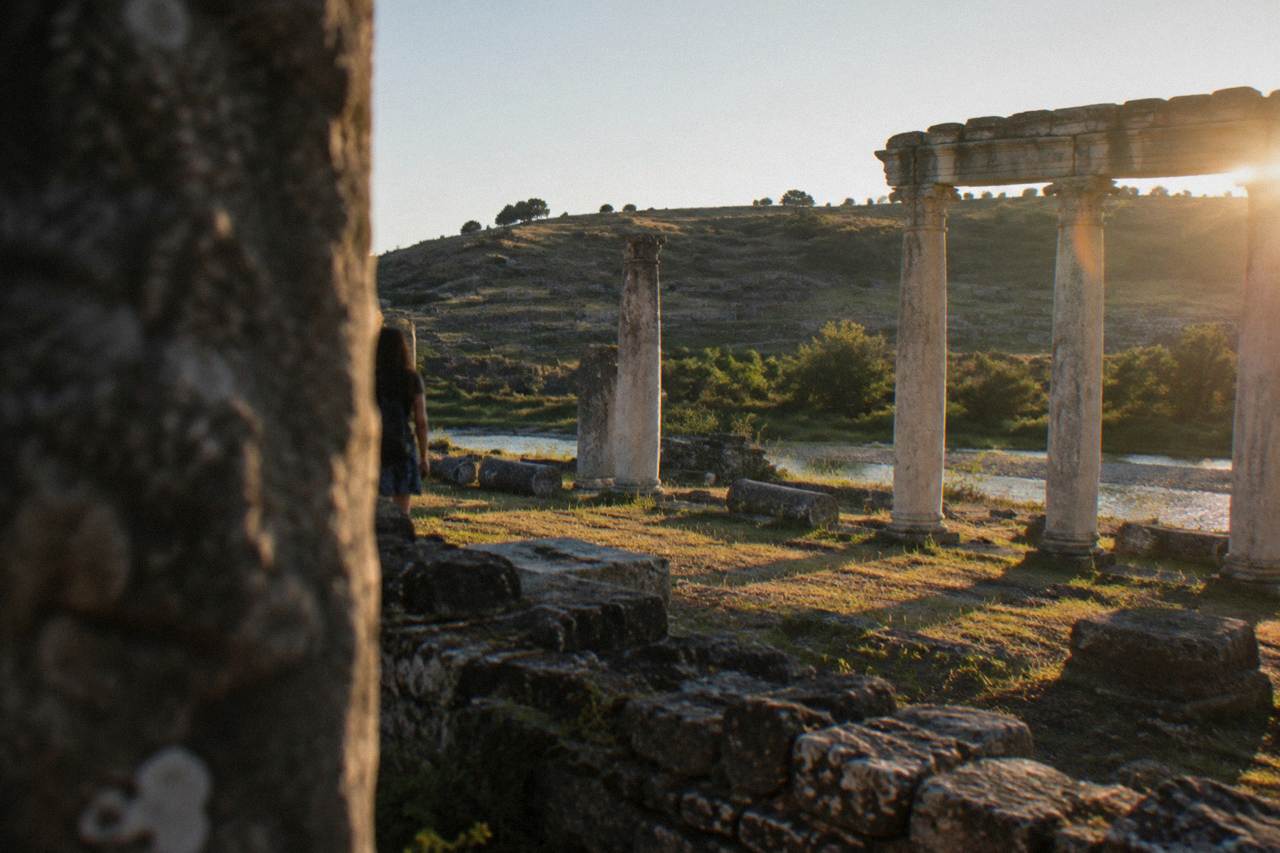
Apollonia was a founding-era ancient city near the village of Pojan in central Albania, reached from Berat as a road trip across the Myzeqe plain. Its surviving monuments include a theatre, a stoa, city walls and the medieval Church of Saint Mary, plus an on-site archaeological museum. Most visitors treat it as a half-day stop combined with Berat or Ardenica Monastery.
Apollonia sits on a low hill above the Myzeqe plain in central Albania, inland from the coast and west of Berat, the UNESCO World Heritage Ottoman-era hill town on the Osum River that most visitors use as their base. The two places could hardly feel more different. Berat is all whitewashed houses stacked over a river gorge; Apollonia is marble columns, collapsed terraces and silence, the remains of a city that was already a ruin when Berat's Ottoman mansions were being built. This guide from Berat Travel Guide covers what the ancient site actually holds, how the journey from Berat works, what the practical costs look like once you are on the ground, and how Apollonia compares with the other ruined cities of the region.
What Is Apollonia And Why Does It Matter?
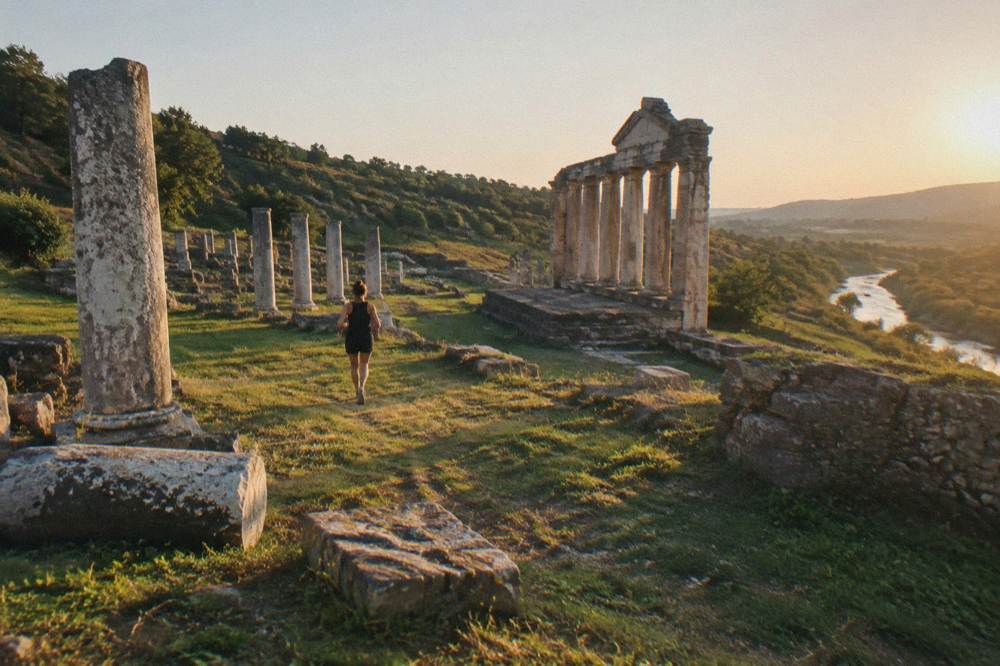
Apollonia was one of the earliest and most important city foundations on the Albanian coast and plain, a Greek colonial city that flourished under Rome before earthquakes and a shifting coastline pushed it into decline. Its ruins now spread across a protected hillside near the village of Pojan, west of Berat, and the walk between them runs from a theatre and civic terraces to a museum inside the medieval monastery of Saint Mary. For anyone based in Berat it is the most consequential ancient site within comfortable day-trip range, and it fills a gap the town itself cannot: Berat's story begins in earnest in the medieval and Ottoman periods, while Apollonia speaks for the centuries before them.
The city was founded by Greek settlers in antiquity and grew wealthy on trade and agriculture, linked to the sea by the Vjosa river system in an era when the coastline reached much closer than it does today. Later Roman rule brought theatres, colonnaded streets and the monumental architecture whose fragments still stand in rows across the hillside. The decline came gradually, as the harbour silted and the economic centre of gravity moved elsewhere, and the settlement shrank to a shadow of itself. What that long abandonment left behind is unusually readable: because a modern city never grew on top of the ancient one, the ruins survived in a completeness that few places in the Balkans can match.
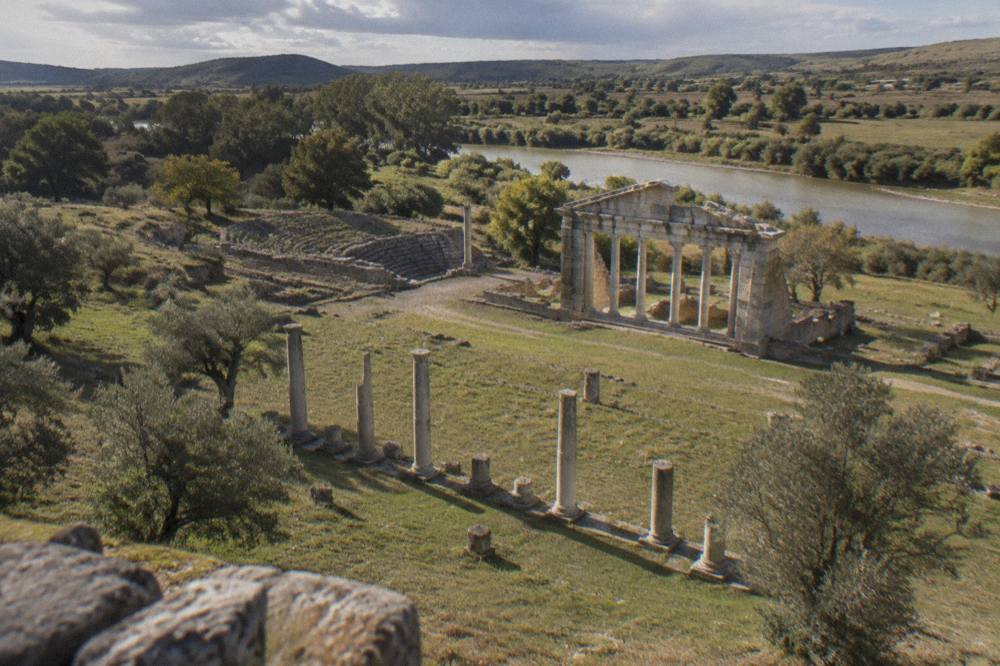
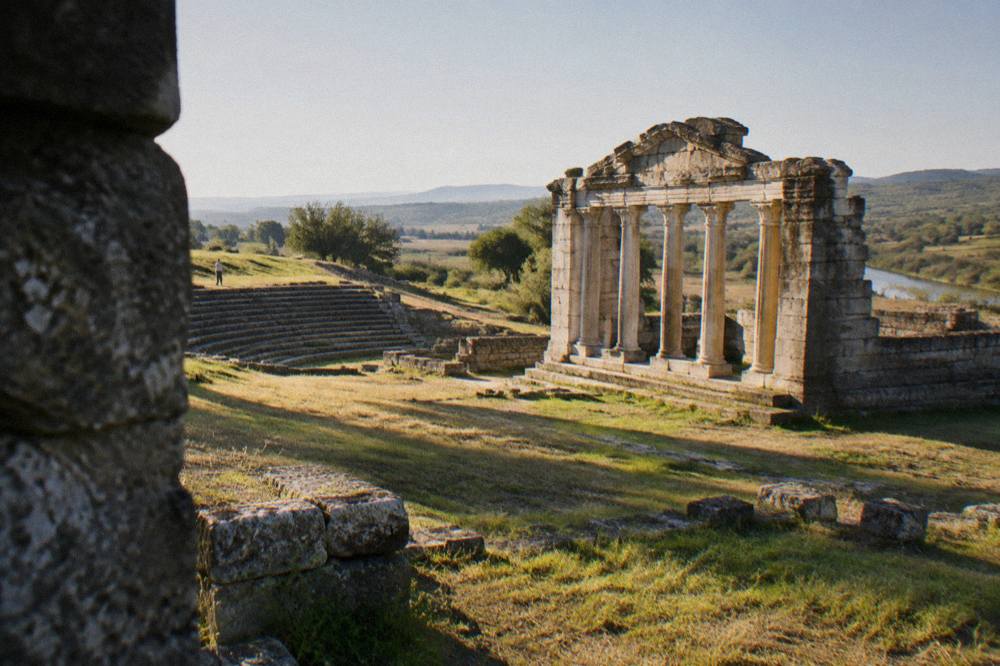
That completeness is the reason the site rewards a full half-day rather than a quick stop. The standing columns of the bouleuterion, the terrace walls, the theatre cut into the slope, the long stretches of fortification and the museum's stone collection all belong to one continuous walk, and the surrounding countryside of olive groves and low hills gives the whole place an atmosphere that is closer to a rural park than to an urban dig. Visitors coming from Berat's dense stone lanes often describe the shift as the best surprise of their trip: two UNESCO-adjacent landscapes within a single day of each other.
The neighbouring region adds context worth knowing. The wider Berat area includes Tomorr National Park, whose main peak Çuka e Partizanit reaches 2,416 metres, and the Osum river, which carves the protected Osum Canyons near Çorovodë to the east. Apollonia belongs to the western, lowland half of that map, and a day trip there pairs naturally with a second day in the mountains, using the Bogove waterfall walk or a canyon float to balance the archaeology.
How Do You Get From Berat To Apollonia?
There is no train and no direct bus link suited to tourists; the practical options are a self-drive across the plain, a taxi arranged for the round trip, or an organised day tour that folds Apollonia-style archaeology into a route planned from Berat or from the coast. Albania's railway network does not reach Berat at all, and national rail reconstruction works, including the Tirana-Durrës-Rinas line, are targeted at end-2027, so rail is simply not part of this journey. The road network is the story here, and it works well: the route crosses the plain on national roads and ends at a signed archaeological park with parking at the entrance.
Self-driving is the choice of most independent travellers, and the general conditions are good. Car rental is available in Berat and in Tirana, with economy rates that move with the season and the provider, and an international driving permit is recommended for non-EU licences. The scenery along the way is flat farmland, villages and olive groves, an easy drive by Albanian standards, and far calmer than the mountain roads you meet heading east toward Tomorr. Once you arrive, the site itself is walked on foot from the gate, so comfortable shoes matter more than horsepower.
If you would rather not drive, a guided tour removes every moving part. The Berat UNESCO & Belshi Lake day tour, a shared coach trip from Tirana, Durres and Golem, is the site's flagship sightseeing format, pairing the old town with a lake stop and an English-speaking guide, and you can Check availability on the operator's live listing before you commit. Travelers coming from the coast town of Vlora can also reach the region on the Vlora to Zvernec, Apollonia and Berat day route, which combines the ancient city with a monastery island in a single loop. Whichever direction you arrive from, book the guided option early in peak summer weeks, when Berat's guesthouses and day trips both fill quickly, as the where to stay in Berat guide explains in detail.
Whichever way you travel, build the day around the opening rhythm of the site. Archaeological parks in Albania are generally staffed through daylight hours, and arriving in the morning gives you cooler walking, emptier columns for photographs and the whole afternoon for the return leg and an evening back in Mangalem. The classic plan is simple: leave Berat after breakfast, walk the site before the midday heat, eat lunch in Pojan or the nearby town of Fier, and be back on Gorica's river bank by early evening. If you are extending into a second day, the one day in Berat itinerary shows how to keep the town itself from being squeezed out by day trips.
What Can You Actually See At The Site Today?
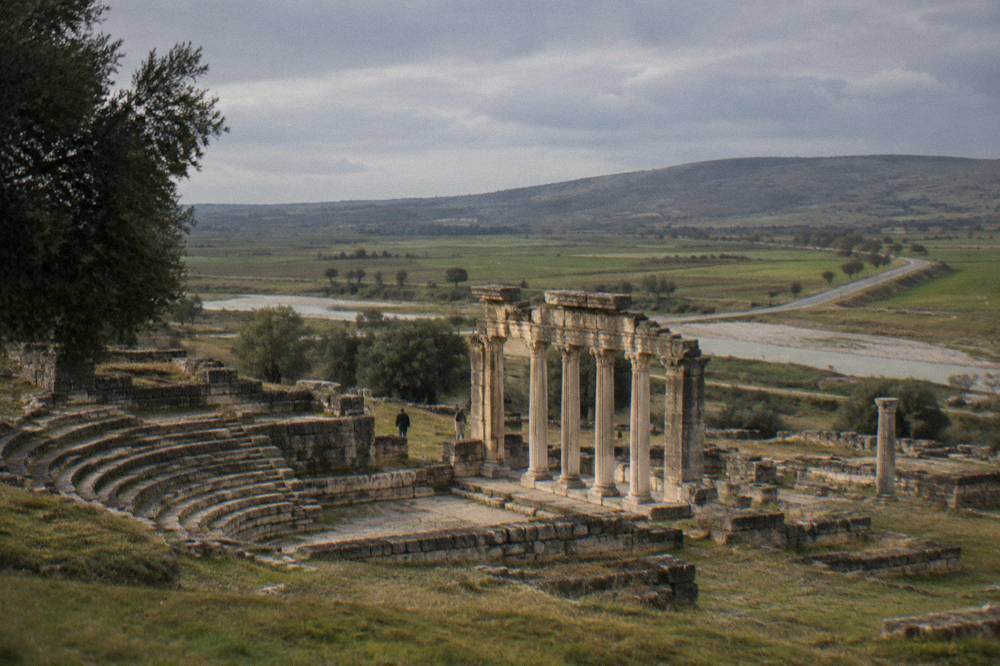
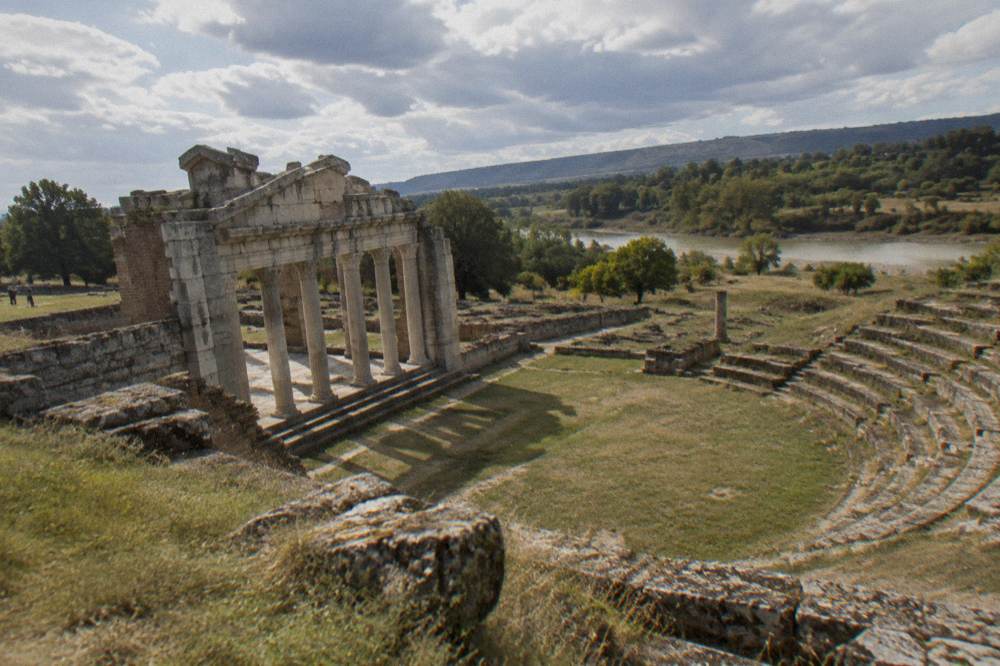
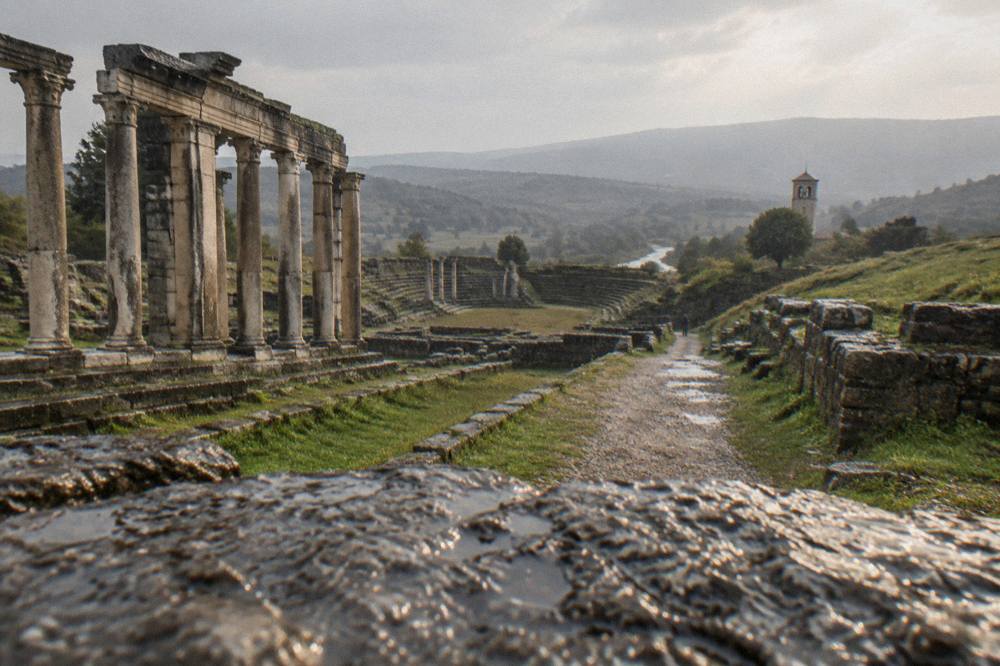
The core sights are the columned facade and stepped seating of the theatre, the long terrace and retaining walls of the civic centre, the monastery-and-church complex that now holds the archaeological museum, and broad stretches of the ancient city walls that you can follow along the hillside. Between them lie scattered sarcophagi, inscribed stone blocks, floor mosaics and the foundations of buildings whose names archaeologists still debate, all left in the open air rather than gathered behind glass. The effect is a site you read with your feet, walking from monument to monument across grass and gravel paths, with the plain stretching away on three sides.
The museum deserves as much time as the ruins, and many visitors give it more. It occupies the buildings of the medieval Church of Saint Mary monastery, whose cloister and bell tower are themselves centuries-old architecture, and inside it the stone sculpture of the ancient city is displayed: portrait heads, monumental figures and architectural pieces that weathered two millennia. The collection is the largest single body of ancient sculpture in this part of Albania, and it explains the ruins outside better than any guidebook paragraph can, because the faces and inscriptions were dug from the terraces you have just been walking.
One honest caveat: Apollonia is a large, quiet site, not a curated spectacle. Restoration and excavation continue in places, some areas are fenced, and signage has improved in recent years but is still uneven between monuments. Bring water, a hat and sun protection in summer, because shade is scarce on the hillside, and the Albanian summer can be brutal, with heat in the worst weeks of July and August capable of topping 40 degrees. A local guide, hired privately or through a tour, transforms the experience for anyone who wants the stories behind the stones; without one, the site is still atmospheric, but you will lean hard on the museum labels.
If a self-guided day trip is your plan, the small-group Berat Castle and Old Town tour shows what a good local guide adds on the Berat side of the day, and the same logic applies at Apollonia itself.
A private guide is the other format worth weighing, and it changes the shape of the day rather than just the commentary: you set the pace on the hillside, linger where the light is good, and fold the museum in when your legs need a rest rather than when a schedule says so. Families and visitors who tire quickly generally do best with that flexibility, since the paths between monuments are gravel and grass, and the theatre seating involves uneven stone steps in places.
How Does Apollonia Compare With Byllis And The Other Ruins Near Berat?
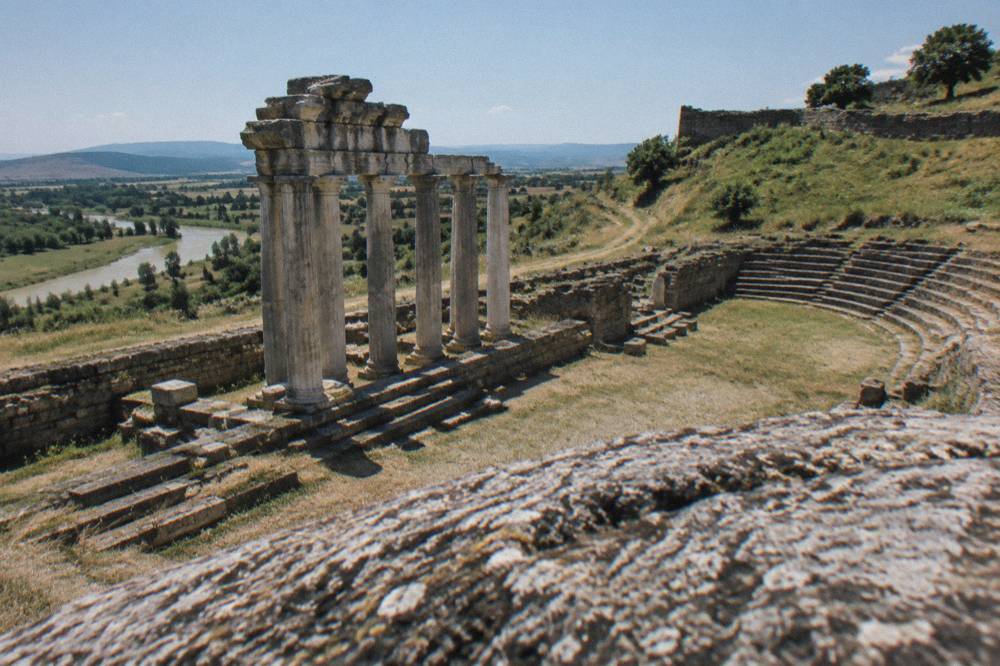
Apollonia is the largest and most museum-equipped ancient site within day-trip range of Berat; Byllis, high on a hill south of the town, is smaller but more dramatically set, with a wall circuit you can walk and views over the whole Vjosa valley; Ardenica Monastery is the region's medieval counterweight, a working monastery rather than a ruin. Together they form a natural triangle, and travellers with two or three days in Berat often take one per day, matching each site to their mood: marble and museums at Apollonia, wind and panoramas at Byllis, frescoes and quiet at Ardenica.
The honest comparison comes down to what you want from the past. Apollonia has the strongest sculpture collection and the most varied monuments, and it is the easiest to reach on good roads, which makes it the default choice for a first visit. Byllis, covered in the Byllis day trip guide, feels wilder and more physical, its Hellenistic walls marching across a ridgetop with almost no modern intrusion, and people who love hiking generally rank it above Apollonia for atmosphere. Ardenica, described in the Ardenica Monastery guide, belongs to a different era altogether, an Ottoman-period monastery with painted interiors, and it slots neatly into the drive back toward the coast or Berat.
| Site | Period you walk through | Signature sight | Character of the visit |
|---|---|---|---|
| Apollonia | Greek foundation through Roman decline | Columned civic monuments and the on-site museum | Long, open, museum-anchored walk |
| Byllis | Hellenistic and Roman hilltop city | Wall circuit and valley panorama | Exposed ridge walk, big views |
| Ardenica Monastery | Medieval and Ottoman | Church frescoes and cloister | Short, shaded, contemplative stop |
| Berat Castle | Medieval fortress quarter, still inhabited | Walls, towers and the Onufri Museum | Uphill walk through a living quarter |
Two practical notes shape the choice. First, Apollonia's museum gives it depth that the others lack, so families and visitors who want explanations alongside stones tend to be happiest there. Second, Byllis and Ardenica are quieter by far; if you are travelling in the peak weeks of summer and want ruins without another camera in the frame, the smaller sites win. For the full spread of what the region offers beyond archaeology, the Gjirokaster day trip guide covers the other UNESCO town to the south, and it makes a good pairing with Apollonia for a two-day dash through the ancient and Ottoman layers of southern-central Albania.
What Does A Day Trip To Apollonia Cost?
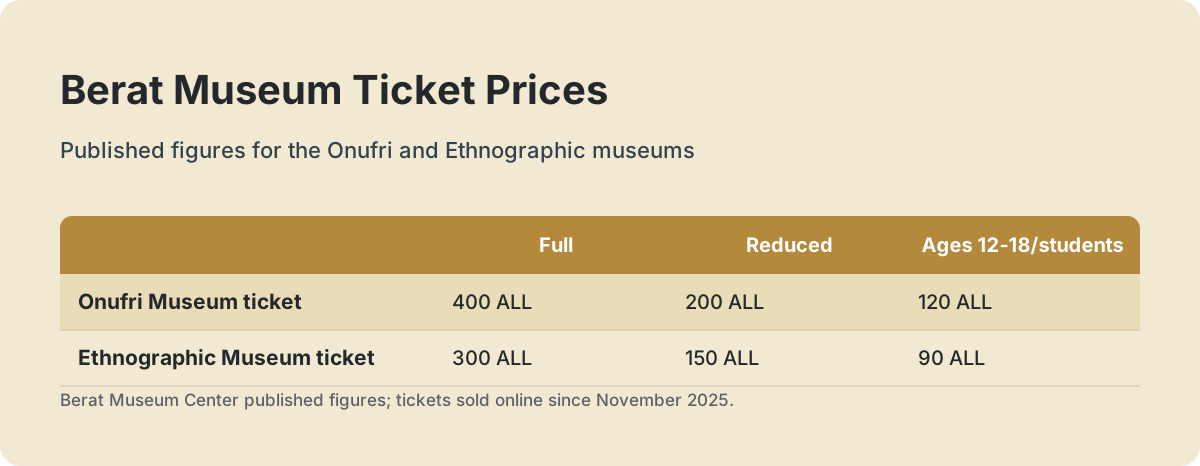
The direct costs are small: the site's own entry is modest by European standards, museum tickets in Berat run 400 lek for the Onufri and 300 lek for the Ethnographic, and daily spending on food and coffee in the region is among the lowest in Europe. The bigger line on the budget is transport: either your rental car or the price of the tour you join, and that is where the range between a bare-bones independent day and a fully guided one opens up. Currency is the Albanian lek everywhere, and the euro is not legal tender, though some tourist businesses accept it informally and usually give change in lek.
Roughly 92 lek to the euro is the working mental rate; the Bank of Albania quoted 1 EUR at 91.97 lek and 1 USD at 80.74 lek in its late September 2026 official listing, and rates move daily. The practical advice is simple: arrive with lek in cash for the day. Old-town Berat and the rural stops around Apollonia remain largely cash territory, cards are accepted at some hotels and larger venues but not reliably at small sites, kiosks or village restaurants, and ATMs outside bank branches can charge foreign cards a few hundred lek per withdrawal. Avoid the standalone machines on tourist streets; use an ATM attached to a bank branch, and carry small notes, as bus fares, tips and village shops all prefer them.
| Item | Typical figure | Notes |
|---|---|---|
| Onufri Museum ticket | 400 ALL | Audio guide 500 ALL, reduced 200 ALL, ages 12-18 and students 120 ALL |
| Ethnographic Museum ticket | 300 ALL | Under 12 free, reduced 150 ALL, ages 12-18 and students 90 ALL |
| Espresso in Berat | Cheap by European standards | Pay in cash, in lek |
| Exchange rate | ~92 ALL per EUR | Official Bank of Albania mid-market rate; rates move daily |
The museum prices above are the Berat Museum Center's own published figures, and they double as a fair guide to what state-run sites in Albania charge generally: a few hundred lek, never tens of euros. One dated improvement matters for planning: since November 2025, tickets for cultural heritage sites, including the Berat museums, have been sold online through the e-Albania platform, valid for one month after purchase, so you can secure museum entry in advance during busy weeks. The state also publishes free admission days, listed below, which can drop the museum half of a Berat stay to zero.
| Free admission day | Who it applies to |
|---|---|
| 18 April | All visitors |
| 18 May | All visitors |
| 21 May | All visitors |
| 29 September | All visitors |
| 28 and 29 November | Albanian citizens only |
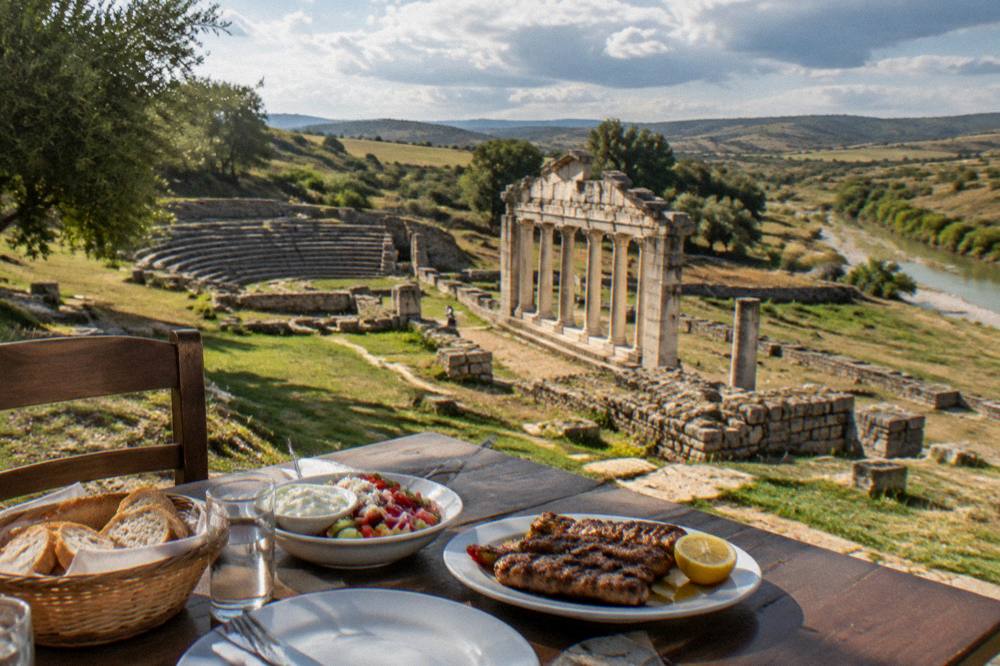
Food on the road is part of the pleasure rather than a cost problem. The region around the plain does simple grilled meat, fresh cheese, byrek and mountain-grown vegetables very well, and Berat itself, whose specialties run from tavë kosi to japrak and qifqi, is covered in the where to eat in Berat guide. For a fuller breakdown of accommodation, meals and transport pricing across the country, see is Albania cheap or expensive, which sets Berat in national context; the short version is that Berat remains one of the better-value bases in the Balkans despite the modest price rises Albania has absorbed recently.
When Is The Best Time To Visit Apollonia?
Spring and autumn are the best seasons: April, May, late September and October combine comfortable walking temperatures with green or golden countryside, while July and August bring heat that can top 40 degrees and little shade on the exposed hillside. Apollonia is an open-air site with almost no tree cover, so season matters more here than for Berat's covered museums, and the difference between a March visit in a jacket and a July visit at midday is the difference between two experiences entirely. Winter visits are possible and beautifully empty, but the plain can be grey and the light flat, and rain concentrates in the November-to-January window, when the coast and lowlands are at their dampest.
Within a day, timing matters as much as within a year. Morning light comes low across the plain and rakes the columns, which photographers appreciate, and the site is at its quietest before tour groups arrive from the coast in late morning. If your trip overlaps early October, an extra reason appears: the Wine and Stories of Berat festival runs 2 to 4 October 2026, three days of Albanian and Kosovo wineries, food stalls and music, which pairs an Apollonia day trip with an evening of tasting in town. The festival's 2025 edition was held 3 to 5 October, so the first weekend of October is becoming a fixture on Berat's calendar.
For planning around weather, the qualitative picture is the one to trust: hot, dry summers, wetter winters with rain peaking between November and January, and July the driest month. No official station normals have been published for Berat, so any precise monthly temperature table you see on a booking site is an estimate rather than an official figure, and this guide deliberately avoids printing one. The Berat weather guide works through the seasons in more detail, including what the shoulder months mean for the castle walk and the canyon trips.
Can You Combine Apollonia With Wineries, Monasteries Or The Canyon?
Yes, and the best combinations use the geography: Apollonia sits west of Berat on the way to the coast, Ardenica Monastery lies close to that same corridor, while wineries, Bogove waterfall and the Osum Canyons sit east and south of town, so most travellers split the region into a western ancient-day and an eastern mountain-day. Trying to do Apollonia and a canyon float in one outing is possible on paper but rushes both; two full days does the region justice, and three lets you breathe.
The wine angle is the most natural companion, because Berat's winemaking is part of the same story of the plain. The region grows native varieties, Shesh i Zi and Shesh i Bardhë among the reds and whites of central Albania, plus Puls, a rare Berat-area white that at least one local producer, Cobo, turns into a traditional-method sparkling wine aged on its lees. A guided winery visit with transfers and tastings is an easy half-day from town, and the Berat wineries day trip guide covers which estates welcome visitors and what a tasting involves.
East of town, the outdoor options stack up quickly. The Osum Canyons near Çorovodë are protected as a natural monument, the rim viewpoints cost nothing to visit, and rafting runs in the spring snowmelt window, roughly March to May or June depending on water, while tubing takes over in the calmer summer and autumn months; the full detail is in the Osum Canyons guide and its rafting companion. The original river tubing trip on the Osumi is the region's most-booked water activity for good reason, and it makes a strong second-day counterweight to a dry, sunny archaeology day.
For a sample week that mixes everything, the two days in Berat itinerary splits the town and the surroundings sensibly, and travellers with longer plans can push on to the mountains with the Mount Tomorr guide, whose national park reaches 2,416 metres at Çuka e Partizanit and hosts the annual Bektashi pilgrimage at the tomb of Abaz Ali each August. Families should also check Berat with kids, since a wide-open ruin site like Apollonia is often easier with children than a museum-heavy city day.
Is Apollonia Worth The Trip From Berat?
For most travellers, yes: Apollonia is the best ancient site within reach of Berat, it costs little, the drive is straightforward, and it supplies exactly the layer of history, Greek, Roman and early Byzantine, that the Ottoman old town does not. The visitors who leave disappointed are usually the ones who expected a Pompeii-scale spectacle or who arrived at midday in August with no water and no guide; the ones who plan for a slow morning walk and then the museum come back with it as a highlight. If your time in the region is a single night, Berat itself should win; with two nights or more, the ancient city earns its day.
The verdict also depends on what else is drawing you. If your trip is built around the outdoors, the canyons, Tomorr and the waterfalls may matter more, and Apollonia can shrink to a stop on the drive in from the coast. If your trip is built around history and photography, the opposite applies, and Apollonia plus Byllis plus the Berat museums is a complete arc from antiquity to the Ottoman age. Either way, the region rewards the traveller who treats it as a cluster rather than a single sight, and the practical pages linked across this guide exist precisely to make that clustering easy.
Common Questions About Apollonia Albania
What Is Apollonia Albania?
Apollonia is an ancient city founded by Greek settlers near the modern village of Pojan in central Albania, west of Berat. It grew into one of the region's most important cities before earthquakes and a retreating coastline drove its decline, and today its theatre, columned monuments, walls and on-site archaeological museum make it the largest ancient site within day-trip range of Berat.
How far is Apollonia from Berat?
Apollonia lies west of Berat across the Myzeqe plain, and the trip is a straightforward drive on national roads. Exact driving times vary with route and traffic, so this guide deliberately avoids printing a figure, but the site sits within comfortable half-day-trip range and is usually combined with lunch in Pojan or Fier before returning to Berat.
Is Apollonia worth visiting compared with Byllis?
Apollonia is bigger, has the museum and is easier to reach, so it suits first-time visitors and families best. Byllis is smaller but set on a high ridge with sweeping valley views and a wall circuit you can walk, which many hikers and photographers prefer. With two days, do both.
Can you buy Apollonia tickets online?
Since November 2025, Albania's e-Albania platform sells tickets online for state museums and cultural heritage sites, including the Berat museums, and tickets are valid for one month after purchase. Check the site's official listing for current Apollonia availability before a peak-season visit.
What should I bring for a day at the site?
Water, a hat, sunscreen and closed shoes, because the hillside has almost no shade and summer heat can top 40 degrees. Cash in lek is wise for entry, snacks and any village stops, since cards are not reliably accepted outside Berat's larger hotels and restaurants.