Berat To Saranda
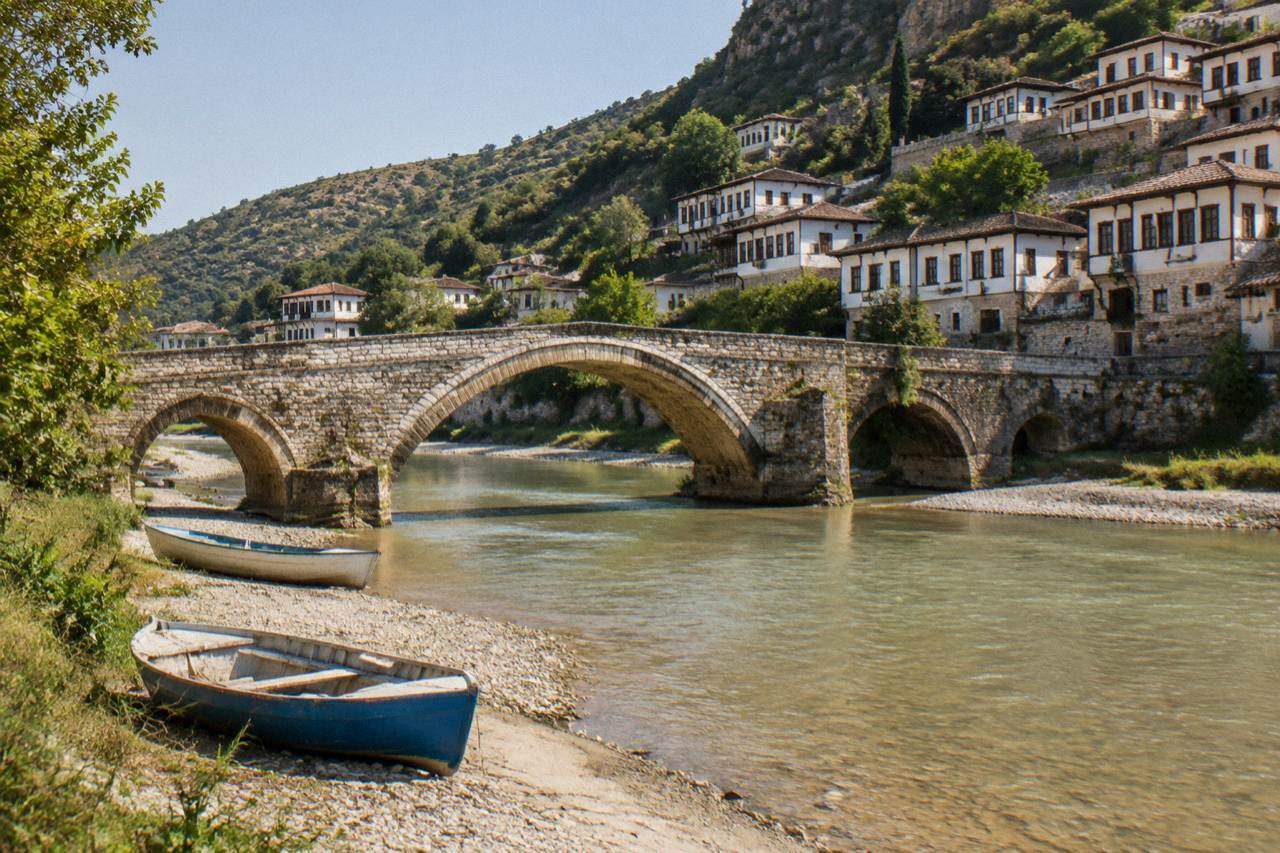
Berat sits deep inland in central Albania, and the trip from its hillside of windows down to the Ionian coast at Saranda is one of the country's great travel days. Here is how the road, the buses and the stops along the way actually work.
Short answer
Berat has no train and no airport, so the journey to Saranda runs by road, usually south via Gjirokaster or west toward Vlora. Buses and shared furgons leave from the Berat terminal on the SH2. The Tirana to Berat leg runs up to 23 times a day from about 500-600 lek, paid in cash.
Berat is a UNESCO World Heritage Ottoman-era hill town on the Osum River in central Albania, and it is about as far from the sea as any town in the country gets. The trade-off is worth understanding before you plan the run south: the same mountains that keep Berat quiet and cool in its gorge are the ones you cross to reach Saranda, Vlora and the Riviera. This guide lays out the road options from Berat toward the coast and beyond, what the verified transport facts actually say, and where the best stops fall along the way. It also flags the details that catch travelers out, from cash-only bus fares to the car restrictions now in force inside the castle quarter.
How Do You Get From Berat To Saranda?
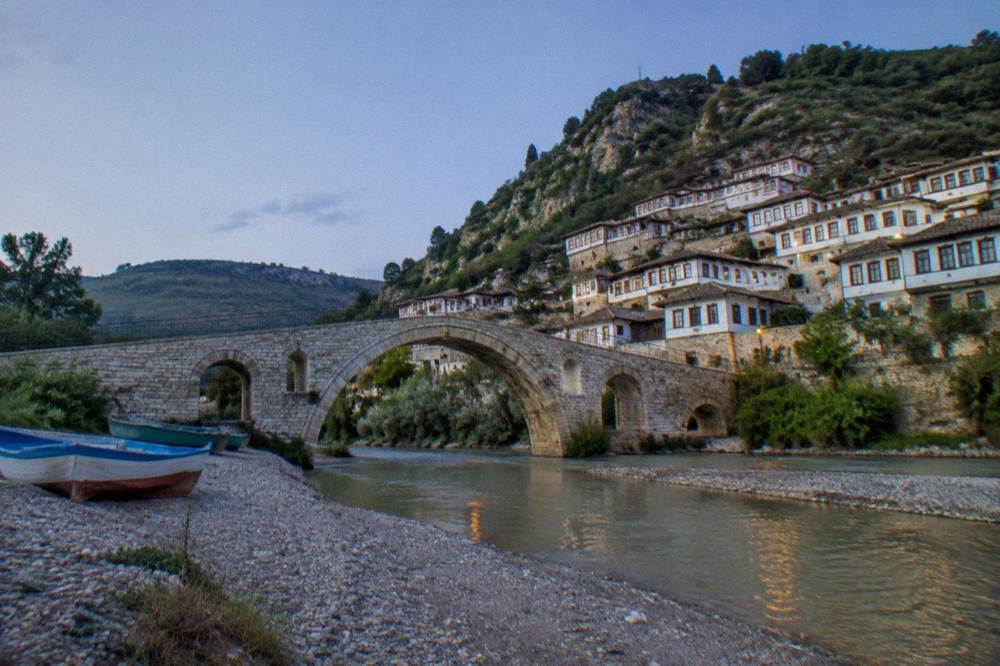
There is no train from Berat and no airport anywhere near it, so every journey to Saranda is a road journey. The usual shape is south: out of the Osum valley, over toward Gjirokaster, then down to Saranda on the Ionian Sea. A second option swings west toward Vlora for the northern Riviera and the Llogara pass. Buses and shared furgons are the backbone of both, supplemented by rental cars and private transfers.
Start by fixing the geography in your head. Berat sits in central Albania, inland, with Saranda in the far south on the coast and Vlora to the northwest. Between Berat and the sea lie mountain ridges, the town of Gjirokaster, and some of the best driving scenery in the Balkans. There is no rail option at all: no passenger train reaches Berat, and the national railway reconstruction now under way targets the Tirana, Durres and airport corridor, with completion work expected toward the end of 2027. Nothing in the current plans touches the Berat to Saranda axis.
That leaves the road, and the road is genuinely good in stretches and slow in others. The main routes are asphalt, mountainous, and shared with furgons, trucks and the occasional flock of sheep. Travelers who want the journey to be part of the trip rather than a delay tend to break it up, and the two natural breaking points are Gjirokaster in the south and Vlora in the west. Saranda is reachable from either, though most people go via Gjirokaster for the shortest crossing.
Here is how the two main road options compare, using only what the verified transport facts support:
| Option | Direction | Usual change point | What the verified facts say |
|---|---|---|---|
| Southern route | Berat south to Gjirokaster, then to Saranda | Often Gjirokaster, sometimes direct in high season | Gjirokaster is the natural overnight or lunch stop; the Berat to Gjirokaster road is covered in our guide to Berat to Gjirokaster travel |
| Western route | Berat west toward Vlora, then down the Riviera | Vlora, or Lushnje and Fier further north | Vlora is the gateway to the northern Riviera and the Llogara pass above the coast |
| Loop option | South via Gjirokaster, back up the coast to Vlora | Overnight stops in both | Combines mountains and sea but needs several days and ideally a car |
One planning note that surprises first-time visitors: Berat's castle quarter, the Kala, began restricting vehicle entry with access limited to residents, pre-booked hotel guests, licensed taxis and a few other categories. If you are renting a car or being driven, expect to park below the walls and walk up. The details are in our guide to driving and parking in Berat.
Where Should You Stop Between Berat And The Coast?
The three stops that earn their place on almost every Berat to Saranda itinerary are Gjirokaster, Apollonia and the Narta lagoon area near Vlora, including Zvernec island. Gjirokaster is another UNESCO World Heritage town with a stone old core; Apollonia is one of Albania's great classical sites; and Zvernec's small island monastery sits in a lagoon an easy detour from the coast road. All three break the drive into humane pieces.
Gjirokaster is the headline stop on the southern route. It shares its World Heritage inscription with Berat, the two towns forming one listed property of historic Ottoman centers, and its grey stone houses stacked on a steep hillside make an obvious contrast with Berat's white walls. Many travelers overnight here rather than push through to Saranda, and the town has the guesthouses and restaurants to make that easy. Our Gjirokaster guide covers the castle, the old bazaar street and how long to give it.
Apollonia works best if you are on the western route or a loop. The ancient city sits inland from Vlora on a plateau, and its ruins, museum and setting make it one of the most rewarding classical sites in the country. Nearby Zvernec island, with its small medieval monastery reached by a causeway through the Narta lagoon, is the classic half-day detour on the way to or from the coast, and birdlife around the lagoon is a bonus in the cooler months.
If you would rather have the coastal stops handled by a local operator, there is a day tour that covers Zvernec, Apollonia and Berat in one run: the Vlora, Zvernec and Apollonia day tour. It runs from Vlora, which makes it a natural fit if your coast stay starts there and you want Berat folded in, rather than the reverse direction. Check availability if that shape suits your dates; most listings carry free cancellation.
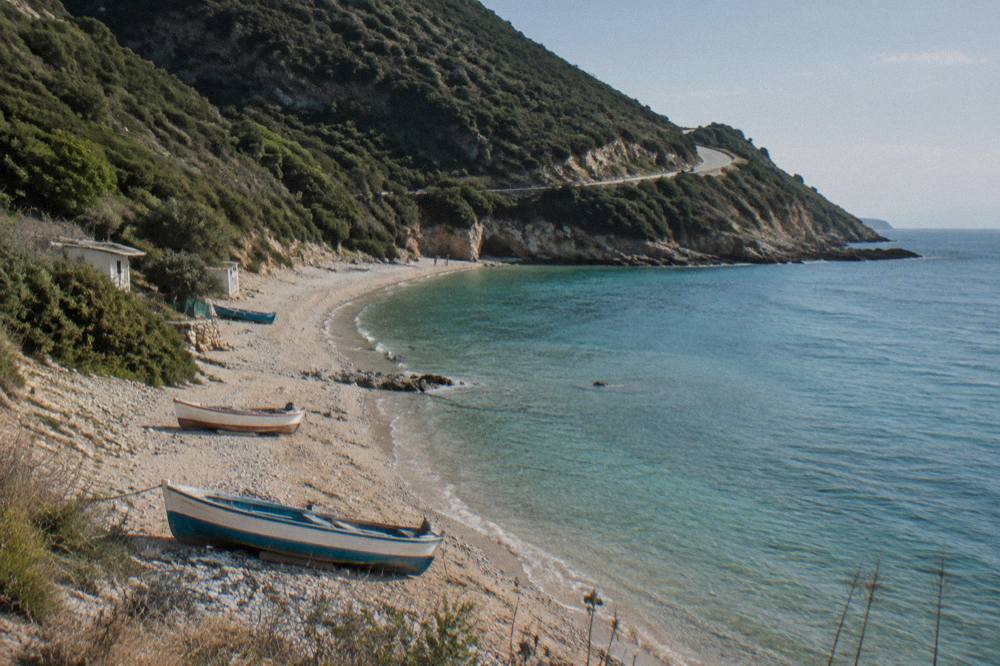
There is no obligation to stop at all three, and in a single push to Saranda most people manage only Gjirokaster. But the whole point of traveling overland in Albania rather than flying past it is that the intermediate country is the attraction. The road from Berat to the sea passes river gorges, olive groves and stone villages that no coastal resort can compete with.
What Are The Options From Berat To Vlora And The Riviera?
Traveling west from Berat toward Vlora usually means changing at least once, most commonly at Lushnje or Fier, the towns that carry east-west traffic across the central Albanian plain. Vlora itself is the gate to the Riviera: south of it the coast road climbs over the Llogara pass before dropping to the beaches at Dhërmi and Himarë and continuing toward Saranda. A car makes this stretch much easier.
Vlora matters to a Berat-based traveler for two reasons. First, it is the practical entry point to the northern Riviera, the stretch of coast between Vlora and Himarë that people usually mean when they talk about the Albanian beaches. Second, it is the terminus of the ferry line to Italy, which matters if your "beyond" extends past Albania itself. Both uses put you on the same east-west corridor out of the Berat region.
The verified transport facts for this corridor are thinner than for the Tirana route, and honesty requires saying so. The pack confirms frequent buses and furgons across central Albania, cash fares, and terminals rather than online booking as the norm; it does not carry a verified timetable or fare for Berat to Vlora specifically. Treat any number a blog or a driver quotes as indicative and confirm it at the terminal the day before. Our Berat bus station guide explains where the terminal sits on the SH2, on the outskirts about 15 to 20 minutes on foot from the old town, and what a taxi to Mangalem should roughly cost.
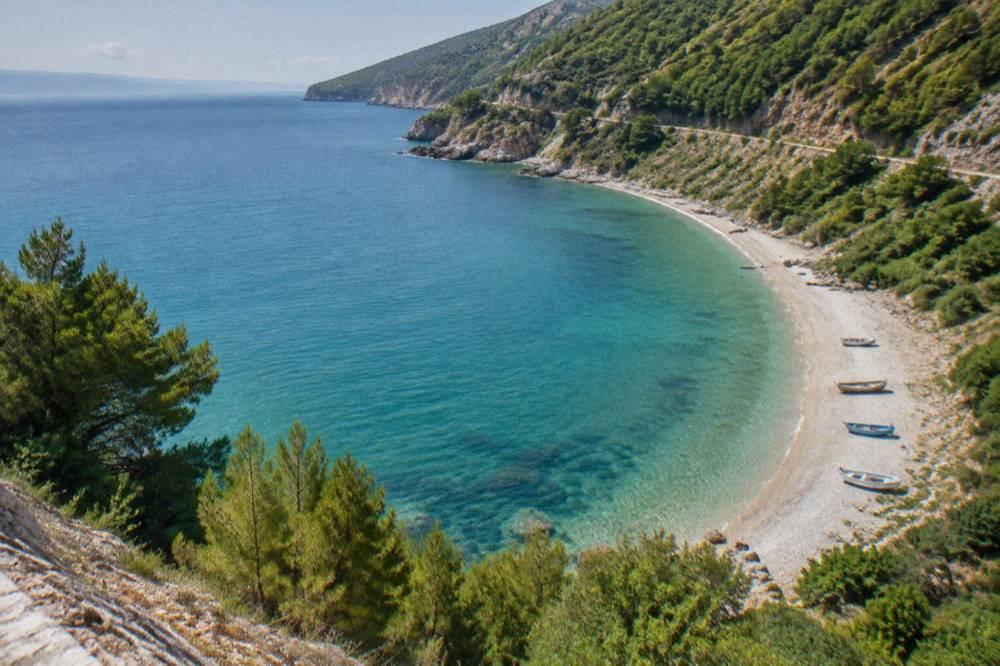
Before you leave Berat entirely, it is worth banking a morning in the old town if you have not used it well yet. The walking tours are the efficient way to do that, and the premium expert-guided walk covers the castle approach, the mosques and the quarters in about two hours, which slots neatly into a departure morning. It is also worth remembering that Berat's own Berat Travel Guide coverage runs deep on the town itself, from the Onufri Iconographic Museum to the Ethnographic Museum, which reopened on 30 May 2026 after a three-year restoration and now displays around 1,300 objects.
The Riviera road beyond Vlora deserves its own warning and its own praise. The climb over the Llogara pass is dramatic, the drop to the sea is dramatic, and in July and August it is also the busiest road in the country. If your dates are flexible, June or September buy you the same water with a fraction of the traffic, a point we develop in the Berat weather guide.
Do You Need A Car To Drive From Berat To The Coast?
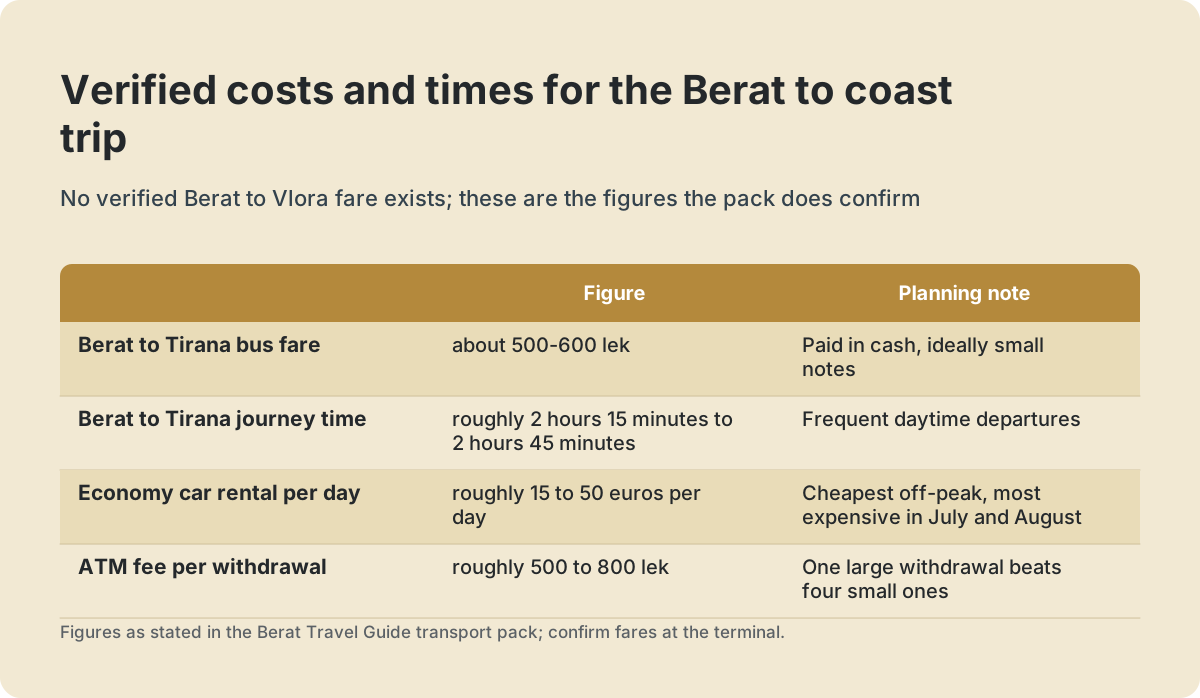
No, but a car changes what the trip can be. Without one you can reach Vlora, Gjirokaster and Saranda on buses and furgons with some patience and at least one change. With one you can stop at Bogovë, the Osum canyon viewpoints, the Llogara pass and any beach that takes your fancy. Rental supply exists in Berat and Tirana, with economy cars roughly 15 to 50 euros a day depending on season.
The verified car-rental picture for Albania runs like this: economy cars cost roughly 15 to 50 euros per day, lower off-peak and highest in July and August, an international driving permit is recommended for non-EU licenses, and one-way rentals exist. Berat itself has some rental supply, though the majority sits at Tirana's airport and in the capital, which is why many travelers pick the car up at the airport on the way in and drop it there on the way out. The airport arrival logistics are covered in our Tirana airport to Berat guide.
Driving standards are the real consideration, not the roads. The main routes are asphalt and in reasonable condition, and no major works were verified on the Lushnje-Berat stretch in the most recent sweep, but rural driving in Albania involves overtaking on blind bends, slow agricultural vehicles, and drivers who treat lanes as suggestions. Our is Berat safe page puts the general picture in context: the country's official advisories note ordinary urban crime and busy roads rather than anything aimed at visitors, and the UK's foreign travel advice carries no warning against any part of the country.
| Driving item | Verified figure or rule | Note for planners |
|---|---|---|
| Economy car rental | roughly 15-50 euros per day | Cheapest off-peak, most expensive in July and August |
| Non-EU licenses | international driving permit recommended | Arrange before arrival, not at the counter |
| One way rentals | available | Berat to coast one-ways are possible but confirm drop-off fees |
| Fuel and tolls | pay in lek | Cash is still the default outside big hotels |
| Castle quarter access | car access into the castle quarter is being restricted | Plan to park below and walk up |
A middle option worth naming is the private transfer. Several local operators run door-to-door transfers from Berat to the coast, priced per car rather than per person, and for a group of three or four the math often beats four bus tickets plus a taxi at each end. Transfer prices are not in the verified pack, so treat any quoted figure as indicative and agree the total, in lek or euros, before loading bags.
How Do Buses And Furgons Actually Work From Berat?
Buses and shared minibuses, known locally as furgons, are the default intercity transport in Albania, and Berat's terminal on the SH2 is where they all leave from. Fares are paid in cash, in lek, to a conductor or the driver. There is no national online booking system for most routes; you turn up, buy, and go. The best-served corridor from Berat is the one to Tirana, with more than twenty departures a day.
The Tirana corridor is the verified anchor of Berat's bus network, and its numbers give you a feel for how the whole system runs. Frequent daytime buses run from Tirana's South-North terminal to Berat, with a journey of about 2 hours 15 minutes to 2 hours 45 minutes and a fare of a few hundred lek paid in cash, ideally small notes. Reverse the direction and the pattern holds: frequent, cheap, no booking needed for most runs.
| Berat to Tirana bus facts | Figure |
|---|---|
| Departures per day | Frequent daytime buses |
| Buses | frequent daytime buses, a few hundred lek, cash |
| Journey time | roughly 2 hours 15 minutes to 2 hours 45 minutes |
| Fare | about 500-600 lek |
| How to pay | cash, small notes |
Coastward, the same mechanics apply with less frequency. Furgons fill up and leave when full, which in practice means more departures in the morning than the afternoon. If your plan is Berat to Vlora or Berat to Gjirokaster and then Saranda, the standard advice holds: get to the terminal early, ask at the kiosk for the next departure in your direction, and be ready to change at Fier, Lushnje or Gjirokaster. Timetables beyond the Tirana corridor are not in the verified pack, so treat anything you read online as a rumor until confirmed on the ground.
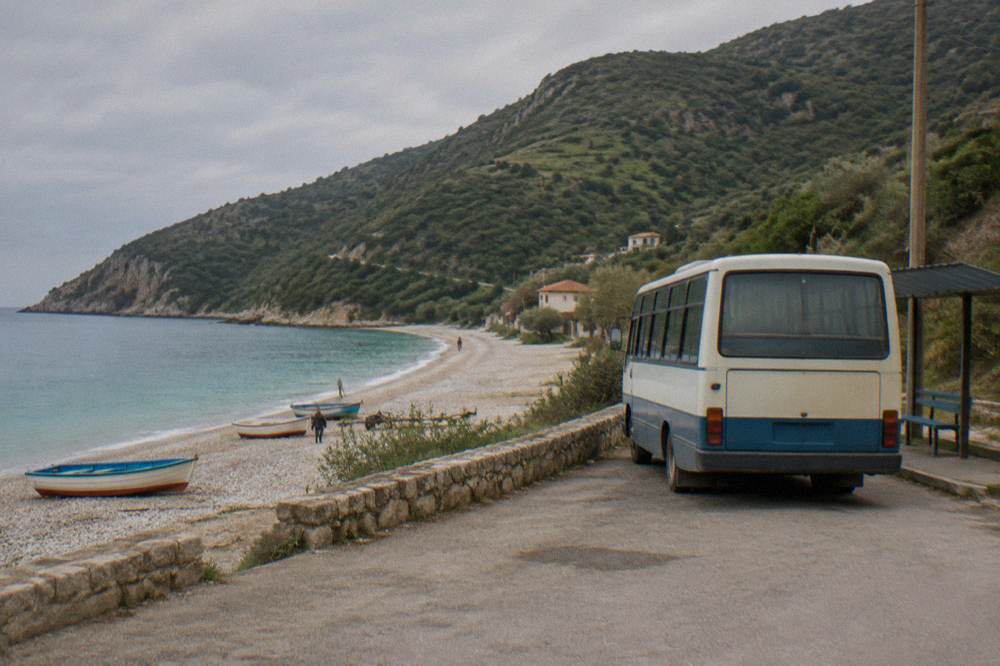
One habit worth building wherever you travel in Albania: keep a few thousand lek in small notes accessible. Old-town Berat is largely cash territory, buses are cash only, and ATMs charge foreign cards fees of roughly 500 to 800 lek per withdrawal, so one large withdrawal beats four small ones. Our money and currency in Albania guide goes deeper on cards, exchange and what the lek buys.
When Is The Best Time To Travel From Berat To The Coast?
Late spring and early autumn are the sweet spot: May, June and September give you passable water for swimming, lighter traffic on the Llogara pass, and mountain roads that are neither snow-affected nor oven-hot. July and August are the full season, with the busiest roads, the highest rental prices and summer heat that can top 40 degrees inland. Winter trips are possible but the coast largely shuts down and daylight is short.
The verified seasonal markers give the year its rhythm. On the adventure side, the rafting season on the Osum canyon runs from the start of February to mid-June, when snowmelt keeps the river high, and tubing takes over from mid-June into November as levels drop and the weather turns the canyon into a heat refuge. That makes late spring a genuinely two-climate trip: you can raft out of Berat in the morning heat of the gorge and swim off a beach the next day.
The calendar also carries events worth building a trip around. The Wine and Stories of Berat festival runs 2 to 4 October in 2026, spread across venues in town with wineries from Albania and Kosovo pouring, and it sits right in the shoulder season when the coast is still warm. In the other direction, the Bektashi pilgrimage to Mount Tomorr, held every August, ran 18 to 25 August in 2026 with roughly 600,000 pilgrims expected on the mountain; expect road restrictions and crowds in the Berat region that week.
| Season marker | Window | Why it matters for a coast trip |
|---|---|---|
| Osum canyon rafting | 1 February to 14 June | High water from snowmelt; pair with a cool-month visit |
| Osum canyon tubing | 15 June to November | Calmer water; the summer canyon day out |
| Wine and Stories of Berat festival | 2-4 October 2026 | Shoulder-season event; coast still swimmable |
| Mount Tomorr pilgrimage | every August; 18-25 August in 2026 | Road restrictions around Berat that week |
| Peak coastal season | July and August | Busiest roads, highest prices, hottest inland |
Summer heat is not a joke in the Osum valley. On 20 July 2026, Berat recorded the highest values in the country on what was reported as the hottest day of the year, with shade readings around 42 degrees, and that kind of inland heat is a real argument for either starting your drive at dawn or shifting the trip to June. The qualitative picture is consistent: hot, dry summers and wetter winters, with rain concentrating from November through January.
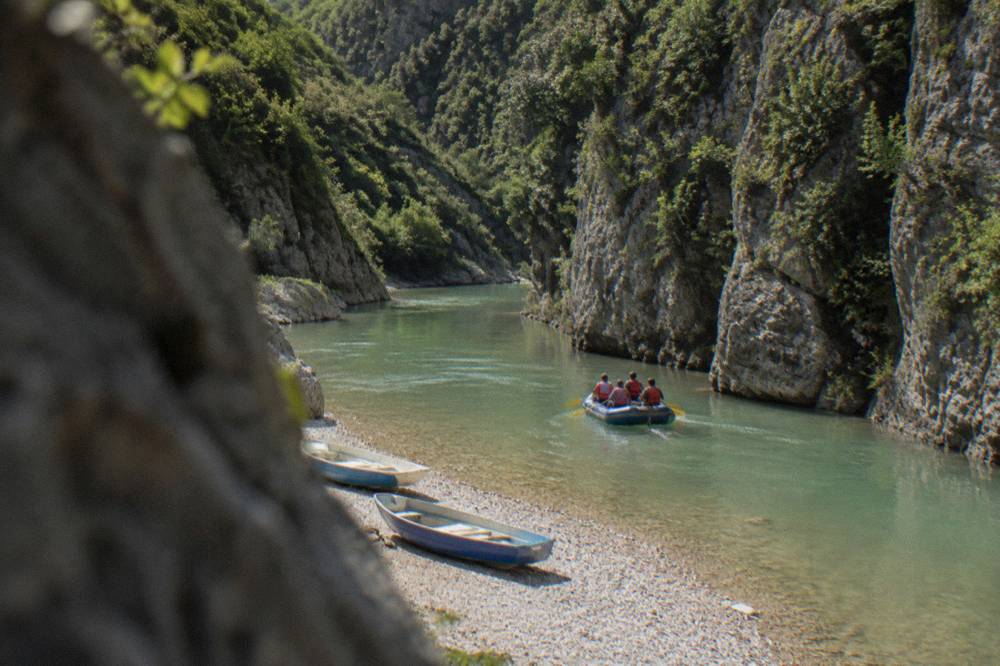
If you are timing a departure around a canyon morning first, the seasonal rafting and tubing trip out of Berat is the one to look at, since it moves with the water calendar described above.
Can You Visit Gjirokaster And Saranda In One Trip From Berat?
Yes, and most overland travelers do exactly that: Berat, then Gjirokaster, then Saranda is the classic three-stop southern Albania run. Done at a comfortable pace it takes four to six days. Done in a rush it can be squeezed into two long days, but you lose the point of it, because Gjirokaster rewards an evening walk and Saranda rewards a slow morning.
The logic of the sequence is simple. Berat and Gjirokaster are the two halves of the same World Heritage listing, Berat having joined Gjirokastra on the World Heritage List in 2008, and seeing them back to back lets you read the contrast deliberately: Berat white, riverside and built around windows, Gjirokaster grey, ridge-top and built around stone. From Gjirokaster the road drops south past the Blue Eye spring toward Saranda, and from Saranda the options open again: Corfu by ferry across the strait, or the coast road back north.
Ferry note for the "beyond" part of your trip: Saranda is the main Albanian port for Corfu, with short crossings in season. Check current schedules locally, as they are not in the verified pack. For the landward continuation, the southern corridor is covered fully on our Berat to Gjirokaster page, which pairs with this one to complete the route down to the Ionian.
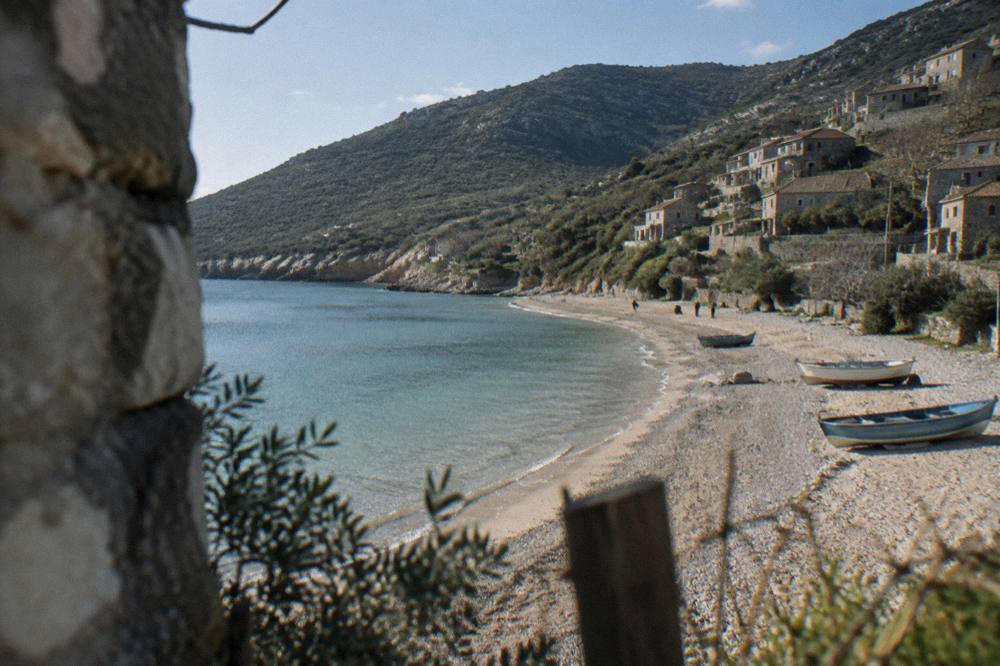
If your return leg passes back through Tirana or Durres, the long day tours that depart from the coast cities can fold Berat in as a stop rather than a base. The Belshi Lake and UNESCO heritage day tour from Tirana and Durres is the busiest of these, running a long loop into the Berat region, and it suits travelers who finish their trip on the coast but want the inland sight without the repositioning.
What Should You Sort Out Before Leaving Berat For The Coast?
Three things: cash, tickets and timing. Withdraw enough lek in Berat before you go, since the coast in peak season is friendlier to cards but buses and small businesses never are. Confirm your bus or transfer at the terminal the day before rather than trusting a blog timetable. And decide your first coast stop deliberately, because arriving in Saranda at dusk without a room in August is a mistake you only make once.
Cash first. The lek is Albania's currency, the euro is not legal tender even though some tourist businesses accept it informally and give change in lek, and the official rate hovers around 92 lek to the euro and about 81 lek to the US dollar. ATM fees on foreign cards run roughly 500 to 800 lek per withdrawal, so withdraw once and well. Day-to-day costs stay low: a shot of raki runs about 2 euros.
| Everyday item | Typical price |
|---|---|
| Cheap restaurant meal | cheap by European standards, cash in lek |
| Mid-range dinner for two | cheap by European standards, cash in lek |
| Cappuccino | cheap by European standards, pay in cash in lek |
| Shot of raki | about 2 euros |
| Bank of Albania rate | roughly 92 lek per euro, 81 lek per US dollar |
Entry rules deserve one paragraph before the practicalities. Albania is not an EU member and not in the Schengen area, so days spent here do not count against a Schengen 90/180 allowance. UK and EU citizens stay visa-free for up to 90 days in any 180-day period, and US citizens can stay up to a year without a residency permit. Passports should have at least three months of validity beyond departure.
| Citizenship | Verified allowance |
|---|---|
| US | visa-free stay up to one year |
| UK | up to 90 days in any 180-day period |
| EU and Schengen states | up to 90 days in any 180-day period, ID card accepted for EU citizens |
Safety numbers are worth saving offline. The general emergency number 112 works from any phone, including without credit or SIM; ambulance is 127, fire is 128, and the police short number 129 is also widely cited alongside 112.
| Service | Number |
|---|---|
| General emergency (any phone) | 112 |
| Ambulance | 127 |
| Fire | 128 |
| Police short number | 129 |
Accommodation is the last lever. Berat's guesthouses are cheap by European standards, with cash in lek the norm, and the choice between Mangalem, Gorica and the castle walls is covered properly in where to stay in Berat. Down on the coast, prices climb steeply in July and August, and our Berat costs guide gives the inland baseline you can compare against.
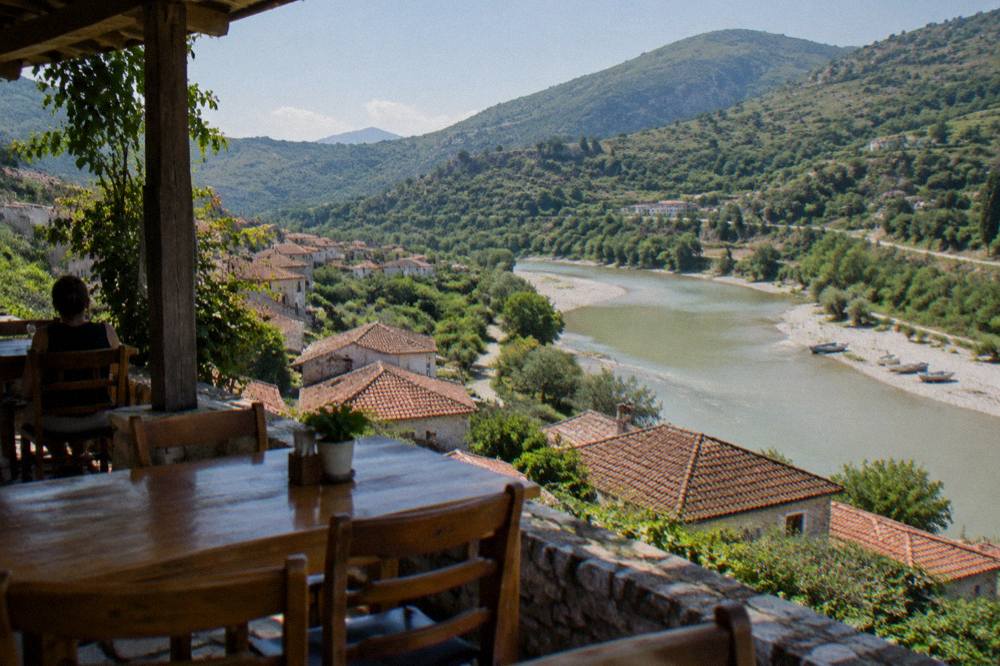
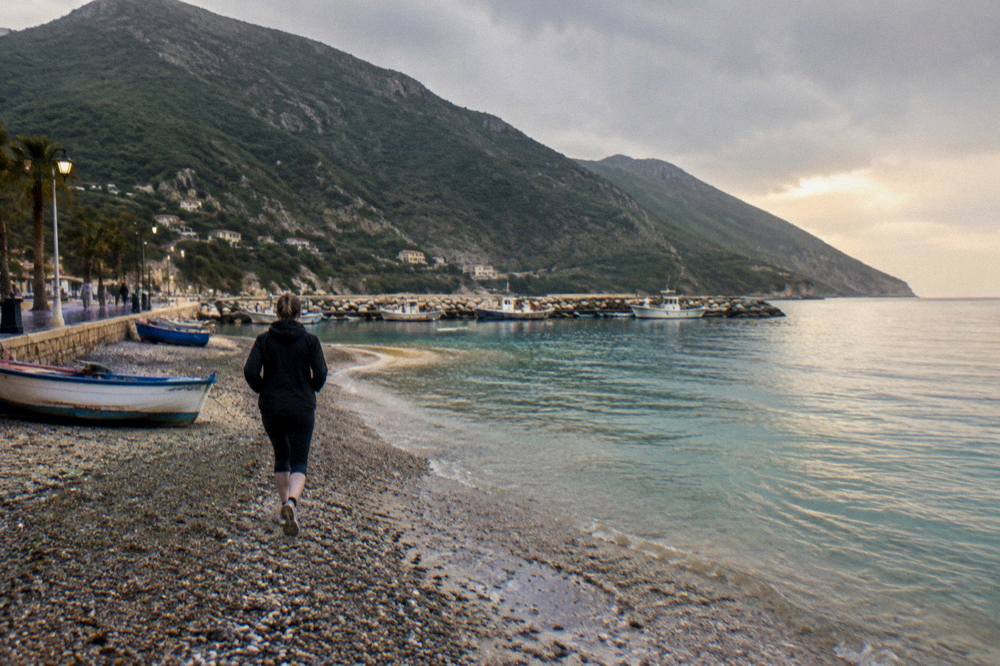
However you run it, the Berat to Saranda corridor is one of the few routes in Europe where a two-week trip can hold a castle, a canyon, two World Heritage towns, a lagoon monastery and four kinds of beach without ever crossing a border. Leave room in the plan for the stops you did not know about yet.
Common Questions About Traveling From Berat To The Coast
How do you get from Berat to Saranda?
Entirely by road. There is no train to Berat and no airport nearby, so the journey runs south by bus, furgon, rental car or private transfer, most often with a stop or a change at Gjirokaster. Allow a full day for the trip if you are using public transport, and break it at Gjirokaster if you can.
Is there a train from Berat to the coast?
No. No passenger train reaches Berat at all. The national railway work under way targets the Tirana, Durres and airport corridor with a view to late 2027, and nothing in the verified plans extends to Berat or the coast.
Where do buses from Berat to the coast leave from?
From the Berat bus terminal on the SH2, on the town's outskirts, roughly a 15 to 20 minute walk from the old town or a short taxi ride. Fares are paid in cash in lek, and for most coastward routes there is no online booking: you buy at the terminal on the day.
Is it worth stopping in Gjirokaster between Berat and Saranda?
Yes. Gjirokaster shares its World Heritage inscription with Berat, and the contrast between the two towns is the best single reason to travel overland rather than skipping ahead. An overnight gives you the evening light on the stone houses and a castle visit without rushing.
Do you need a car for the Albanian coast from Berat?
Not strictly, but it helps. Buses and furgons reach Vlora, Gjirokaster and Saranda with changes, while a car opens the canyon viewpoints, the Llogara pass and the smaller beaches. Economy rentals run roughly 15 to 50 euros a day, and an international driving permit is recommended for non-EU licenses.
What is the best month to travel from Berat to the coast?
May, June and September balance everything: swimmable sea, lighter traffic on the coast road and mountain roads that are neither icy nor furnace-hot. July and August bring peak heat that can top 40 degrees inland, the busiest roads and the highest prices.