Gorica Berat
Gorica is the other half of Berat, Albania: the quieter, greener Ottoman quarter on the right bank of the Osum River, facing Mangalem's famous window walls. This guide covers what to see, where to cross, where to eat and sleep, and the day trips that start from its lanes.
Short answer
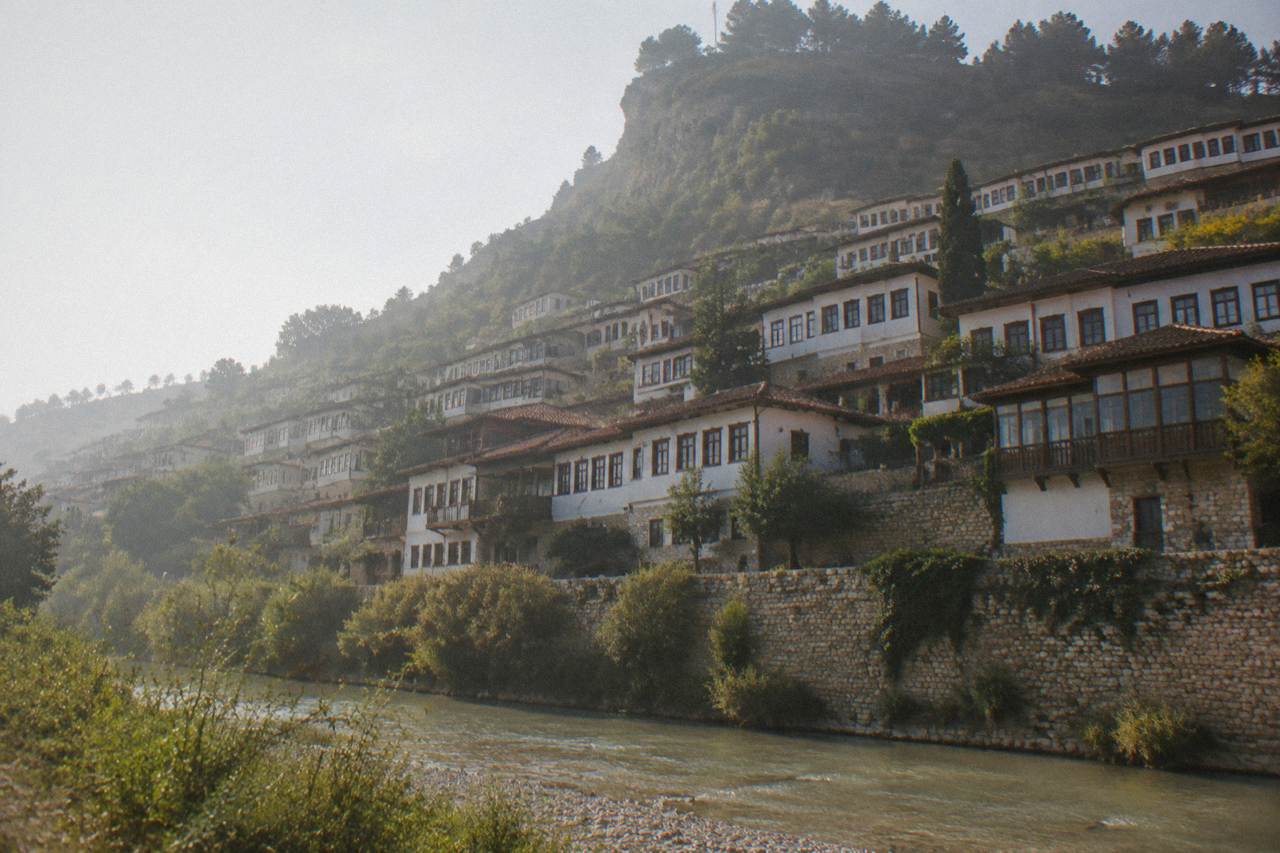
Gorica is the historic quarter on the east bank of the Osum in Berat, central Albania, part of the UNESCO World Heritage town. Expect cobbled lanes, the Gorica Bridge, small churches, a castle trail and the best views of the thousand-window Mangalem hillside. Museum entries run 300-400 lek, and most of Gorica is free to wander.
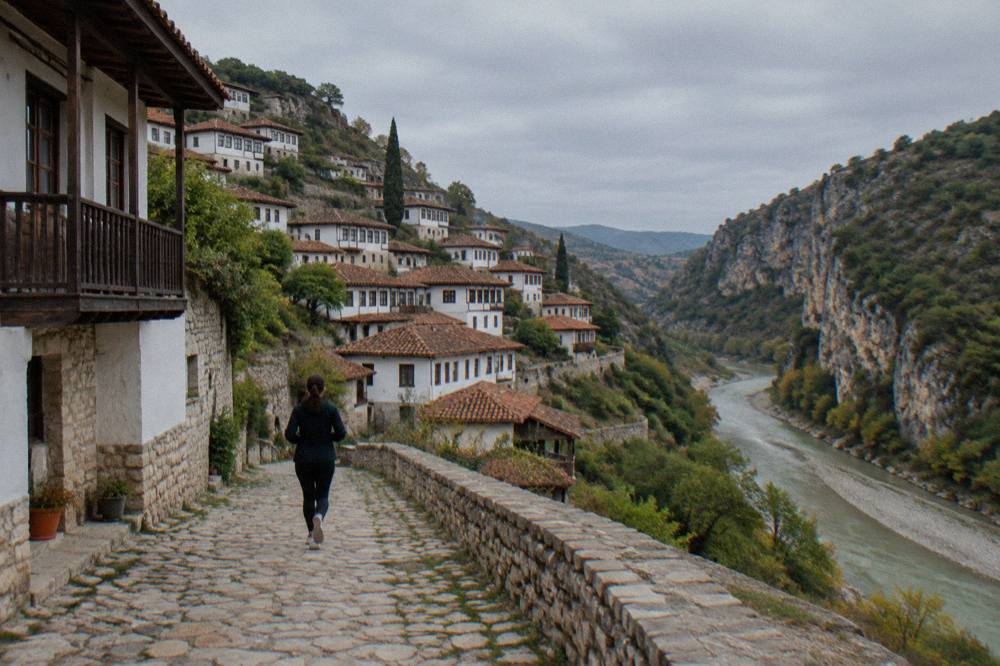
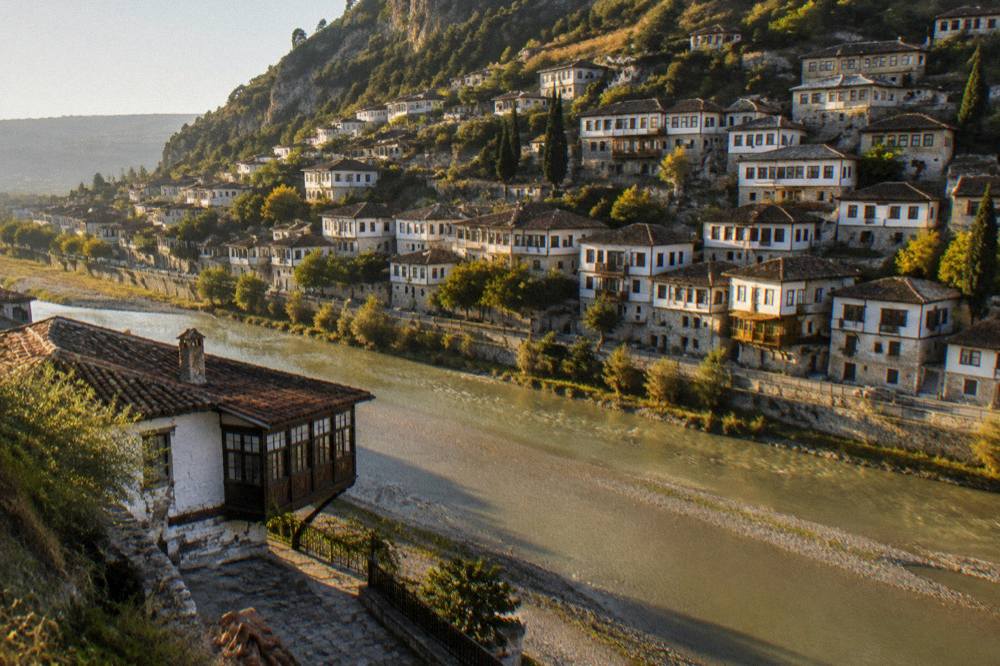
Gorica is the quieter half of Berat, a UNESCO World Heritage Ottoman town in central Albania, stretched along the east bank of the Osum River beneath a pine-covered hill. From almost any point on its lanes you look straight across the water at Mangalem, the stacked white houses whose endless windows give Berat its famous nickname. Most visitors spend their day on the Mangalem side and cross the old bridge only for a photograph; those who stay longer discover that Gorica holds its own churches, its own castle trail, its own guesthouses and by common consent the best sunsets in town. This guide walks the quarter end to end, from the bridge to the hilltop trail, and then outward to the canyon, mountain and winery trips that leave from its doorsteps.
What Is Gorica In Berat, Albania?
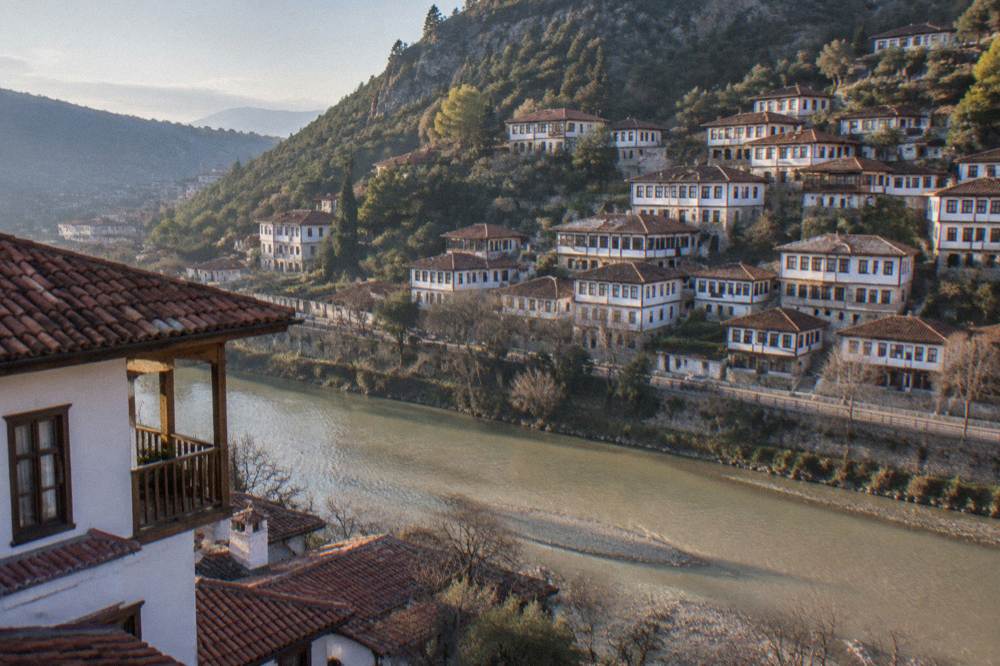
Gorica is one of the two Ottoman quarters that make up historic Berat, lying on the right bank of the Osum River opposite Mangalem, inside the UNESCO World Heritage property. Berat was added to that listing in 2008 as an extension of Gjirokastra, inscribed 2005, and UNESCO describes the town as a rare example of a well-preserved Ottoman town. Where Mangalem climbs its hillside in dense rows, Gorica spreads along the water and up a greener slope, quieter and more residential.
The name simply means "little mountain" or hillock, and the quarter earns it. Its lanes rise gently from the Gorica Bridge toward St Nicholas Church and the start of the Gorica castle trail, one of several completed heritage-upgrade projects confirmed in Albania's January 2026 state-of-conservation report to UNESCO. The same report lists restorations for the Gorica quarter's historic urban landscape, new parking near the Old Gorica Bridge and an upgraded Iliaz Vrioni square, work that has made the quarter noticeably tidier without sanding off its character.
What surprises many first-time visitors is how lived-in Gorica remains. This is not a museum district. Families hang laundry between stone walls, grandmothers guard doorways, and small shops sell bread and cold drinks a few steps from the most photographed bridge in Albania. The 2023 census counted 62,232 residents in the whole Berat municipality, and a good share of the old-town fabric on both banks is still ordinary housing. That balance, heritage and daily life in the same streets, is exactly what the UNESCO inscription was meant to protect.
For orientation, think of Berat as a spine. The Osum River runs roughly north to south, the Gorica Bridge joins the two quarters at the narrowest point, and everything worth seeing sits within a fifteen-minute walk of that crossing. The old town guide covers both banks together, while this page concentrates on the east side. If you are still deciding whether the town deserves your time at all, the is Berat worth visiting answer runs through the case for and against.
How Do You Cross From Mangalem To Gorica?
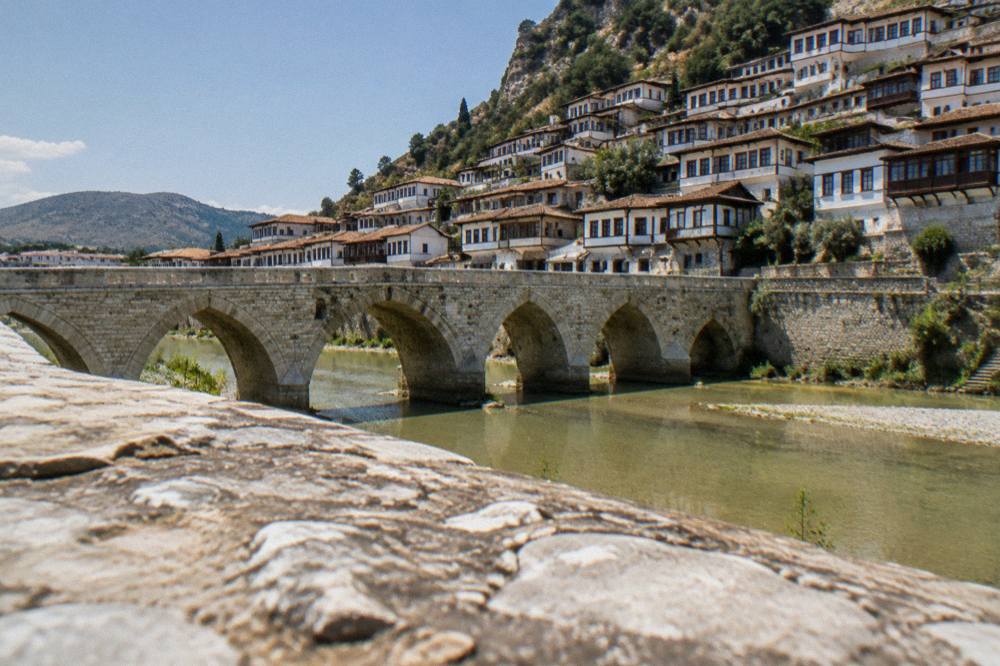
The Old Gorica Bridge is the classic crossing, a stone pedestrian bridge at the foot of both quarters and the busiest single viewpoint in Berat. Walking it takes a minute or two; photographing it properly takes longer, because the arches line up with the Osum's reflections in both directions. A second, larger road bridge upstream carries traffic, and since July 2025 a new 290-metre EU-funded panoramic bridge over the Osum connects the villages of Bilçë, Malinat and Zhitom with Berat, diverting through-traffic away from the heritage centre.
The practical advice is simple: cross the old bridge on foot, early or late. In the middle of the day it fills with tour groups walking over from Mangalem for the classic photo of the window walls seen from Gorica's bank. By late afternoon the crowds recede, the light turns warm on the white facades, and the riverside cafés below the bridge fill with people waiting for sunset. The dedicated Gorica Bridge guide covers the structure's history, arches and photo angles in depth.
One thing to get right: the Osum here is an inland river, not tidal, with no estuary and no coast. Water levels shift with the seasons, high and fast with spring snowmelt, low and clear in late summer, and the riverside promenade on the Gorica side is a pleasant flat walk either way. The new panoramic bridge upstream is worth the stroll if you have a spare hour; it opened on 1 July 2025 and was funded by the EU Delegation to Albania explicitly to keep heavy vehicles out of the historic streets, part of the same mobility plan that is slowly reshaping how traffic reaches Berat Castle.
Getting to Gorica from further afield is straightforward. Buses and furgons arrive at Berat's terminal on the SH72 outside the centre, and from there it is a short taxi hop or a longer walk to the bridge; the Berat bus station guide has the detail. If you are driving, note that parking near the Old Gorica Bridge was upgraded as a heritage project, but spaces remain limited in the old streets, and the driving and parking advice is worth reading before you commit to a car.
| Crossing | Type | Best For | Watch Out For |
|---|---|---|---|
| Old Gorica Bridge | Stone pedestrian arch bridge | Photographs, atmosphere, both banks | Peak-day crowds mid-morning |
| Upstream road bridge | Vehicle and foot traffic | Access from the north, avoiding old lanes | Not scenic |
| New 290 m panoramic bridge | Road bridge, opened July 2025 | River views, through-traffic relief | Longer walk from the centre |
What Are The Top Things To See In Gorica?
Gorica's core sights are the Gorica Bridge, the Church of St Nicholas perched above the quarter, the lanes of the historic urban landscape itself, and the start of the Gorica castle trail, all free to see except the museums. The two big museums, Onufri and the Ethnographic, sit on the Mangalem and castle side, so Gorica is where you come for streets, churches and views rather than ticketed attractions. Allow half a day to walk it properly.
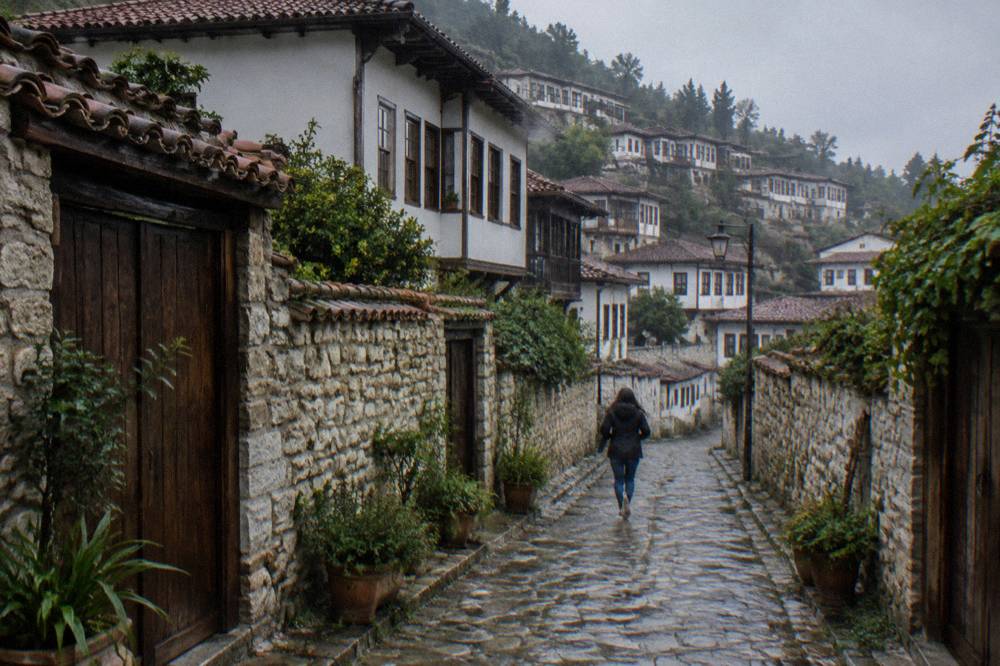
Start at the bridge and climb. The lanes above the crossing are the quarter's real attraction: stone walls, wooden gates, occasional glimpses of the river between houses, and cats on every warm step. St Nicholas Church, with its position at the top of the inhabited slope, is the quarter's landmark; small churches dot the lanes below it, and several are only open on request, so peek through gates rather than expecting a fixed schedule. Nothing here needs a ticket, which is why Gorica pairs so well with the free things to do angle many travellers care about.
The castle trail is the one sight with a real plan attached. The project that upgraded it appears in the January 2026 UNESCO state-of-conservation report among completed PIUTD works, alongside the Gorica quarter landscape restoration. The trail climbs from the top of Gorica's streets toward the castle ridge on the far side, joining routes described in detail in the hiking around Berat guide. It is a walk, not a scramble: sensible shoes and a bottle of water cover it, and the reward is the single best view of Mangalem's window walls from above.
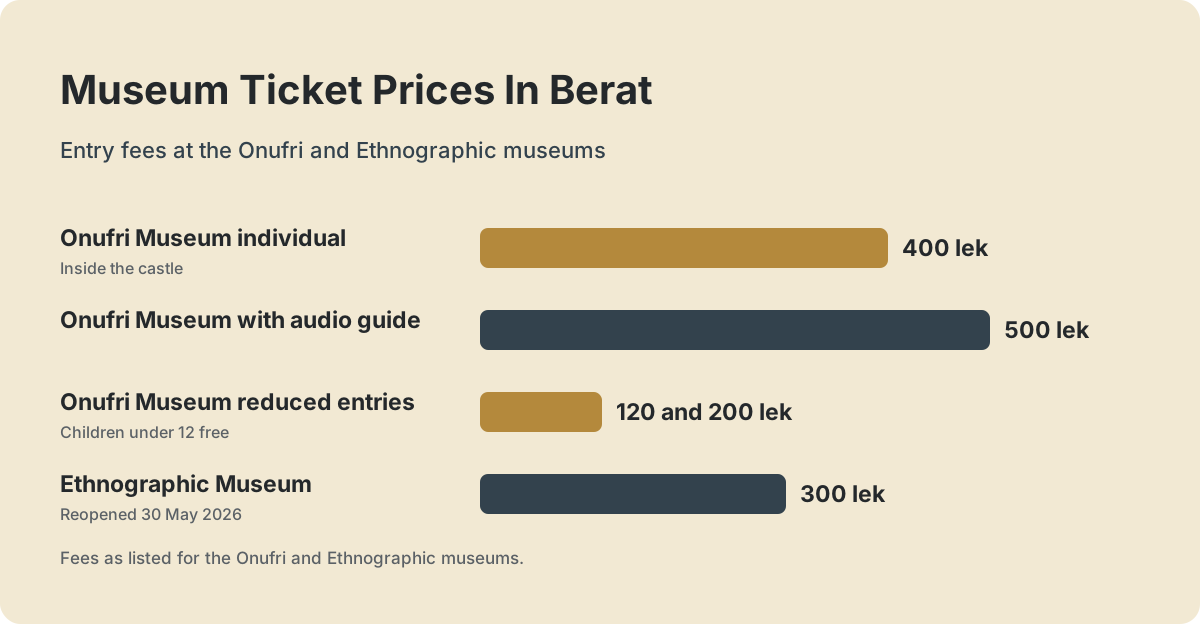
For the ticketed side of Berat, cross back over. The Onufri Iconographic Museum inside the castle charges 400 lek for an individual ticket, 500 lek with an audio guide, with reduced entries at 120 and 200 lek and children under 12 free. The Ethnographic Museum, which reopened on 30 May 2026 after a three-year restoration with around 1,300 objects on display, charges 300 lek, reduced 150 lek, students and ages 12-18 at 90 lek. Both museums run 9:00-18:00 from May through September and 9:00-16:00 Tuesday to Saturday, 10:00-15:00 Sunday, in winter. Onufri has been busy: 58,912 visitors passed through from January to July 2026, a 16 percent rise on the same period a year earlier.
| Sight | Side Of The River | Entry | Notes |
|---|---|---|---|
| Gorica Bridge | Joins both | Free | Best light early and late |
| St Nicholas Church | Gorica | Free to see outside | Openings vary |
| Gorica lanes and steps | Gorica | Free | The quarter's main draw |
| Gorica castle trail | Gorica upward | Free | Sensible shoes advised |
| Onufri Museum | Mangalem/castle | 400 lek | Audio guide 500 lek |
| Ethnographic Museum | Mangalem side | 300 lek | Reopened May 2026 |
A good way to cover both banks without route-finding is a guided walk. A private city tour with optional wine tasting runs through the old lanes with a local guide, and its tour page has the current duration and inclusions. The free-walking option is worth knowing too: tip-based tours led through GuruWalk cover both quarters with a local guru, no price printed because the model is tips-only.
Where To Eat And Drink In Gorica?
Gorica's eating scene is smaller and calmer than Mangalem's, built around a handful of guesthouse kitchens and riverside tables rather than a strip of restaurants, and the dishes to look for are Berat's own: tavë kosi, qifqi and japrak. Restaurant meals in Berat are cheap by European standards, and even the sit-down options stay gentle on the wallet, though it helps to carry cash in lek. Reserve for dinner in summer, when the riverside tables fill.
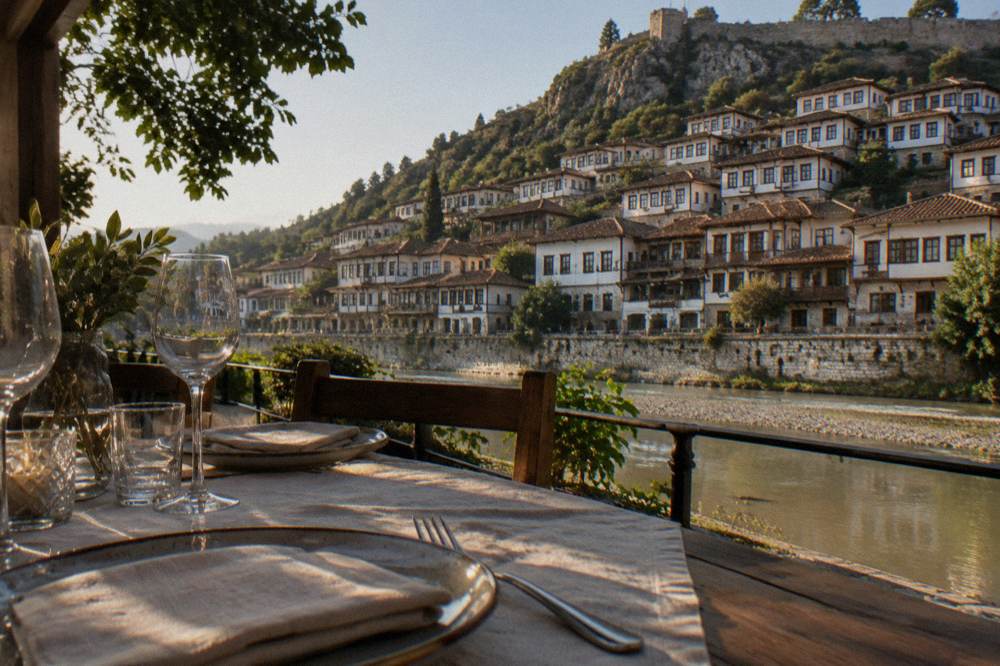
The quarter's advantage at mealtimes is the view: several kitchens on the Gorica bank face the water, so lunch comes with the window walls opposite rather than a wall of other diners. Traditional Albanian food is the default everywhere, and Berat's specialties travel across the bridge intact. Qifqi, the rice dumplings seasoned with mint and fennel that are near-uniquely Berat's, show up as a starter; japrak, stuffed grape leaves, and tavë kosi, lamb baked under a yogurt and egg topping, anchor most menus. The dedicated where to eat in Berat guide names the kitchens worth the walk.
Drinking is a slower business. Rakia, the local fruit spirit, is poured everywhere, often as a welcome from a guesthouse host rather than a menu item; a shot typically costs about 2 euro where it is priced at all. Wine is a bigger story: Berat sits in one of Albania's better wine regions, and the question do they drink alcohol in Albania surprises people who expect a mostly Muslim country to abstain. The regional wineries around nearby villages pour native grapes, Shesh i Zi for reds, Shesh i Bardhë for whites, and a rare local white called Puls that one Berat winery also turns into a traditional-method sparkling. The Berat wineries day trip guide explains which producers you can visit.
If you would rather taste than read, a guided winery tour with transfers and tastings runs from Berat to a regional producer, with three or more wines, raki and snacks on the table; its tour page carries the current price and meeting point. Check availability if that fits an afternoon better than self-driving, since the back roads to the vineyards are easier with a local at the wheel.
| Dish Or Drink | What It Is | Typical Setting |
|---|---|---|
| Qifqi | Fried rice dumplings with mint and fennel | Starter or street snack |
| Tavë kosi | Lamb baked with yogurt and egg | Main course, home-style kitchens |
| Japrak | Stuffed grape leaves | Meze plate |
| Rakia | Fruit spirit, often grape | Poured by hosts, small bars |
| Puls white wine | Rare Berat-area native grape | Winery tastings, some lists |
Where To Stay On The Gorica Side?
Gorica suits travellers who want quiet nights, garden terraces and morning coffee facing Mangalem's windows, and its stays are mostly small boutique guesthouses in restored stone houses rather than big hotels. Typical Berat guesthouses run roughly 44-79 US dollars a night and hotels 43-86 dollars, with the July-August peak pushing rates upward. The pick of Gorica's current options includes Amalia Hotel for families.
Choosing a bank is mostly a temperament question. Mangalem, covered in the Mangalem quarter guide, puts you inside the postcard but also inside the evening bar zone; Gorica trades a five-minute walk for silence, thicker walls and the better sleep. Guesthouses inside the castle walls exist too, the Kala being a lived-in quarter where a centuries-old building next to the Onufri Museum is being converted into an eight-room family guesthouse, but that is a hill-climb commitment. The full breakdown, including free-parking notes for drivers, sits in the where to stay in Berat guide.
A few practical notes from the 2026 picture are worth flagging. Vehicle access into the castle quarter has been restricted since April 2026, limited to residents, pre-booked hotel and restaurant visitors, licensed taxis and suppliers, with a barrier-based Smart Parking system being rolled out; on the Gorica side the new parking near the Old Gorica Bridge is the designated base for cars. Book summer weekends early: Berat's visitor numbers are rising, the Onufri Museum alone drew about 14,000 people in August 2026, and guesthouse capacity in the old town is finite. Everything else covered here is indexed on Berat Travel Guide.
| Stay Option | Bank | Character | Best For |
|---|---|---|---|
| Amalia Hotel | Gorica | Family-run, garden | Families |
| Hotel Gorica | Gorica | Larger, established | Groups |
| Guesthouses in the Kala | Castle | Inside the walls, steep lanes | Heritage immersion |
| Mangalem guesthouses | Mangalem | Central, atmospheric | Nightlife, short visits |
What Are The Best Viewpoints In Gorica?
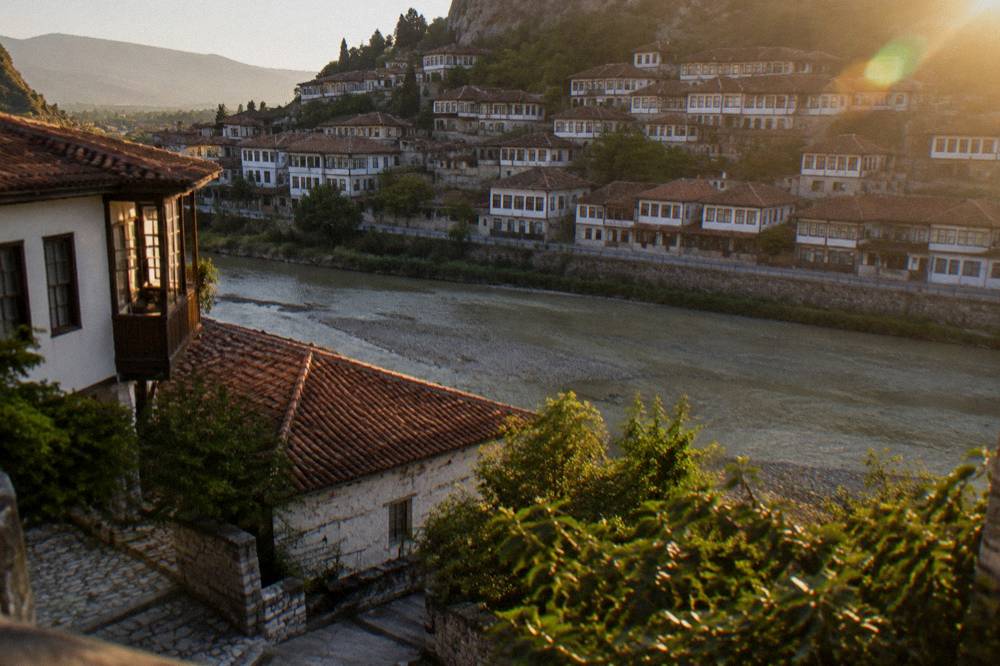
The best Gorica viewpoints are the west bank of the river opposite Mangalem at sunset, the lanes just below St Nicholas Church for a raised angle over the windows, the Gorica Bridge itself for the river-level frame, and the upper castle trail for the whole-town panorama. All of them are free, none needs equipment beyond steady shoes, and the light that flatters Mangalem's white walls arrives in the last hour before the sun drops behind the western ridge.
Photographers should work the golden hour hard. Berat is one of the most photographed small towns in the Balkans, a claim explored in the prettiest town in Albania answer, and the Gorica bank is where the classic compositions live. The full angle-by-angle breakdown, including where to stand for the layered windows shot and which terraces are open to non-guests for a coffee, is in the Berat photography spots guide. Morning works too, but the sun sits behind Mangalem until midday, so the famous faces stay in shadow until early afternoon.
| Viewpoint | Looks Toward | Best Time | Effort |
|---|---|---|---|
| West riverside promenade | Mangalem windows | Sunset | Flat walk |
| Below St Nicholas Church | Mangalem, raised | Afternoon | Short climb |
| Gorica Bridge | River both directions | Early or late | None |
| Upper castle trail | Whole town and Osum | Late afternoon | Moderate climb |
How Hard Is The Gorica Castle Trail Walk?
The Gorica castle trail is a moderate hill walk, not a technical hike: it climbs from the top of Gorica's streets toward the castle ridge on paths upgraded under the completed heritage project, and it takes sturdy shoes, water and about an hour rather than any special gear. The reward is the widest view in town, taking in both quarters, the Osum's course and the Tomorr massif beyond, whose highest point, Çuka e Partizanit, stands 2,416 metres. Go early in summer, when Berat's heat can top 40 degrees.
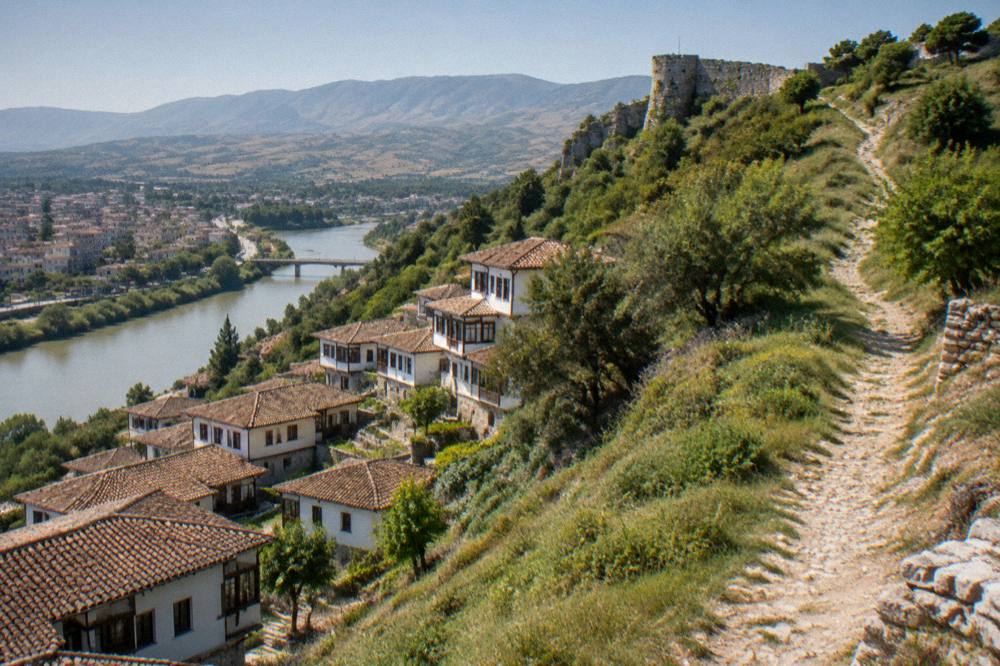
The trail matters to Berat beyond the view. Its upgrade was one of the completed projects listed in the January 2026 UNESCO state-of-conservation report, part of the management work that keeps the World Heritage property in good standing after a 2026 World Heritage Committee decision urged suspension of two contested projects, the Shkëmbi Road and the Osum riverbank works, until heritage impact assessments are completed. Walkers benefit directly: the route is waymarked in stretches that were previously informal goat paths, and the parking project near the bridge means a car can wait below while you climb.
Weather shapes the walk more than fitness does. Berat has hot, dry summers and wetter winters; rain peaks from November through January and July is the driest month. The heat is the real constraint: July and August typically run into the low thirties, and in late July 2026 local reporting marked the year's hottest day with shade readings of 42 degrees in Berat, a useful reminder to start trail mornings early or pick a shoulder month. The Berat weather guide has the seasonal planning detail.
Beyond the ridge, the hills deepen. Tomorr National Park, a protected area, shelters brown bear, wolf and birds of prey on the massif that dominates Berat's skyline, and a dedicated day trip covers Tomorr Mountain and the lakes of Dardhë in about six hours from town; its tour page shows what the day includes. Note one timing wrinkle: the annual Bektashi pilgrimage to the tomb of Abaz Ali on Tomorr runs in August, the 2026 edition from 18 to 25 August, with police traffic restrictions around the Kulmak Tekke, so mountain plans that week need flexibility.
What Day Trips Run From Gorica?
The strongest day trips from Gorica's doorstep are the Osumi Canyon and Bogovë waterfall to the east, the wineries of the Berat region on the town's southern flank, Apollonia's Roman ruins to the northwest, and Gjirokastra, the other half of the shared UNESCO inscription, as a full-day run south. Rafting on the canyon runs in spring, roughly March to early June on snowmelt, while tubing carries the summer season. Tomorr, at 2,416 metres, covers the mountain option in about six hours.
The Osumi Canyon is the marquee trip. Near Çorovodë in the Skrapar region, the canyon is protected as a natural monument, its rim viewpoints, including Vrima e Nuses and the old Italian bridge, cost nothing to visit, and the drive from Berat runs about an hour to an hour and a half on fully paved roads. Rafting operators run the spring window when snowmelt fills the gorge, tubing takes over through summer and autumn, and the Bogovë waterfall, inside Tomorr National Park, is a short forest walk from the village, roughly half an hour to an hour round trip on an easy trail. The Osumi Canyon guide has the season detail, and the wineries option is covered earlier in this page.
For a second full day, Apollonia's ruined Greco-Roman city makes an easy northwest loop, and Gjirokastra, the stone town with which Berat shares its World Heritage listing, is the long-haul choice; both have dedicated guides at Apollonia and Gjirokastra. A vineyard day closer to home is the 4x4 off-road and vineyard wine tasting trip, the featured option for this page, which pairs the tracks behind Gorica with a tasting at a regional producer; the tour page has the itinerary and current terms.
| Day Trip | Direction From Gorica | Season Notes | Time Needed |
|---|---|---|---|
| Osumi Canyon rafting | East, Çorovodë | Spring snowmelt, roughly March to early June | Full day with a tour |
| Osumi Canyon tubing | East | Summer to autumn | Half to full day |
| Bogovë waterfall | East, Tomorr park | Best spring and early summer | Half day |
| Tomorr Mountain and Dardhë lakes | Northeast | Avoid August pilgrimage week | About 6 hours |
| Berat wineries | South | Year-round | Half day |
| Apollonia | Northwest | Year-round | Half to full day |
| Gjirokastra | South | Full-day run | Full day |
When Is The Best Time To Walk Gorica?
The best months for Gorica are the shoulder seasons, spring and autumn, when temperatures are mild, the lanes are quiet and the light is generous, with early October adding the Wine and Stories of Berat festival, dated 2-4 October for 2026. Summer brings the crowds and the heat, winter brings short days and rain, and any visit should carry cash because the old town is largely a cash economy and ATMs charge fees.
The festival deserves a line of its own. Wine and Stories of Berat runs for three days in early October with wines from Albanian and Kosovo wineries, music, artisanal cheese and olive oil, and a wine contest judged by Austrian and Italian oenologists, and it is the one weekend when Gorica's riverside genuinely buzzes. Beyond it, spring delivers the canyon's best water and green hills, and autumn pairs warm days with harvest tables. For a broader country-level view, the best month to go to Albania answer puts Berat's season in context.
Money and safety close the practical loop. The currency is the Albanian lek, roughly 92 to the euro on the official rate, and the euro is not legal tender, though some tourist businesses accept it informally and give change in lek; cards work at some hotels and larger spots but Mangalem and Gorica remain mostly cash territory, with ATM fees around 500-800 lek for foreign cards. Albania is not in the EU or Schengen, so entry is a national matter, not a Schengen crossing; UK and EU citizens get 90 days in any 180 visa-free, and US citizens up to a year. The country sits at Level 2 on the US advisory scale, exercise increased caution, with the what to be careful of in Albania answer covering the street-level detail. Emergency numbers are 127 ambulance, 128 fire, 129 police, and 112 as the general number that works from any phone.
Common Questions About Gorica Berat
What Is Gorica in Berat, Albania?
Gorica is the historic Ottoman quarter on the east bank of the Osum River in Berat, central Albania, facing the more famous Mangalem quarter. It lies inside the UNESCO World Heritage property "Historic Centres of Berat and Gjirokastra", listed in 2008 as an extension of Gjirokastra's 2005 inscription. Its lanes, the Gorica Bridge, St Nicholas Church and the castle trail are the quarter's main draws.
How Do You Cross From Mangalem To Gorica?
The Old Gorica Bridge, a historic stone arch bridge, is the classic pedestrian crossing at the foot of both quarters. A road bridge upstream carries vehicles, and since 1 July 2025 a new 290-metre EU-funded panoramic bridge over the Osum connects the villages of Bilçë, Malinat and Zhitom with Berat, diverting through-traffic away from the heritage centre.
What Are The Top Things To See In Gorica?
Gorica's sights are the Gorica Bridge, the Church of St Nicholas above the lanes, the restored historic urban landscape itself, and the Gorica castle trail, all free to see. The Onufri Museum at 400 lek and the Ethnographic Museum at 300 lek sit across the river on the castle and Mangalem side, so Gorica is the streets-and-views half of the town.
Where To Eat And Drink In Gorica?
Gorica's kitchens are small guesthouse restaurants and riverside tables, quieter than Mangalem's strip. Look for Berat's own dishes: qifqi rice dumplings, japrak stuffed grape leaves and tavë kosi, with rakia poured as a welcome and local Shesh and Puls wines on many lists.
Where To Stay On The Gorica Side?
Typical Berat guesthouses run roughly 44-79 dollars a night. Book summer weekends early, since old-town capacity is finite and visitor numbers are rising.
When Is The Best Time To Walk Gorica?
Spring and autumn are the best seasons: mild days, quiet lanes, and in early October the Wine and Stories of Berat festival, dated 2-4 October for 2026. Summer heat can top 40 degrees and winter rain peaks from November through January, so climb the castle trail early or pick a shoulder month.